


AI infrastructure doesn’t run on chips alone. It needs power, capital, and the right people to bring it all together.
Following our inaugural edition in July, Energy Investors Forum (EIF) returns to Dallas on June 15–16, 2027. We’re bringing together institutional investors, lenders, energy developers, data center and bitcoin mining operators, and industry leaders for candid discussions and meaningful connections at the intersection of energy, compute and capital.
We’re now shaping the speaker lineup and welcoming discussions with prospective partners and participants. More details below.
Now let’s dive in.
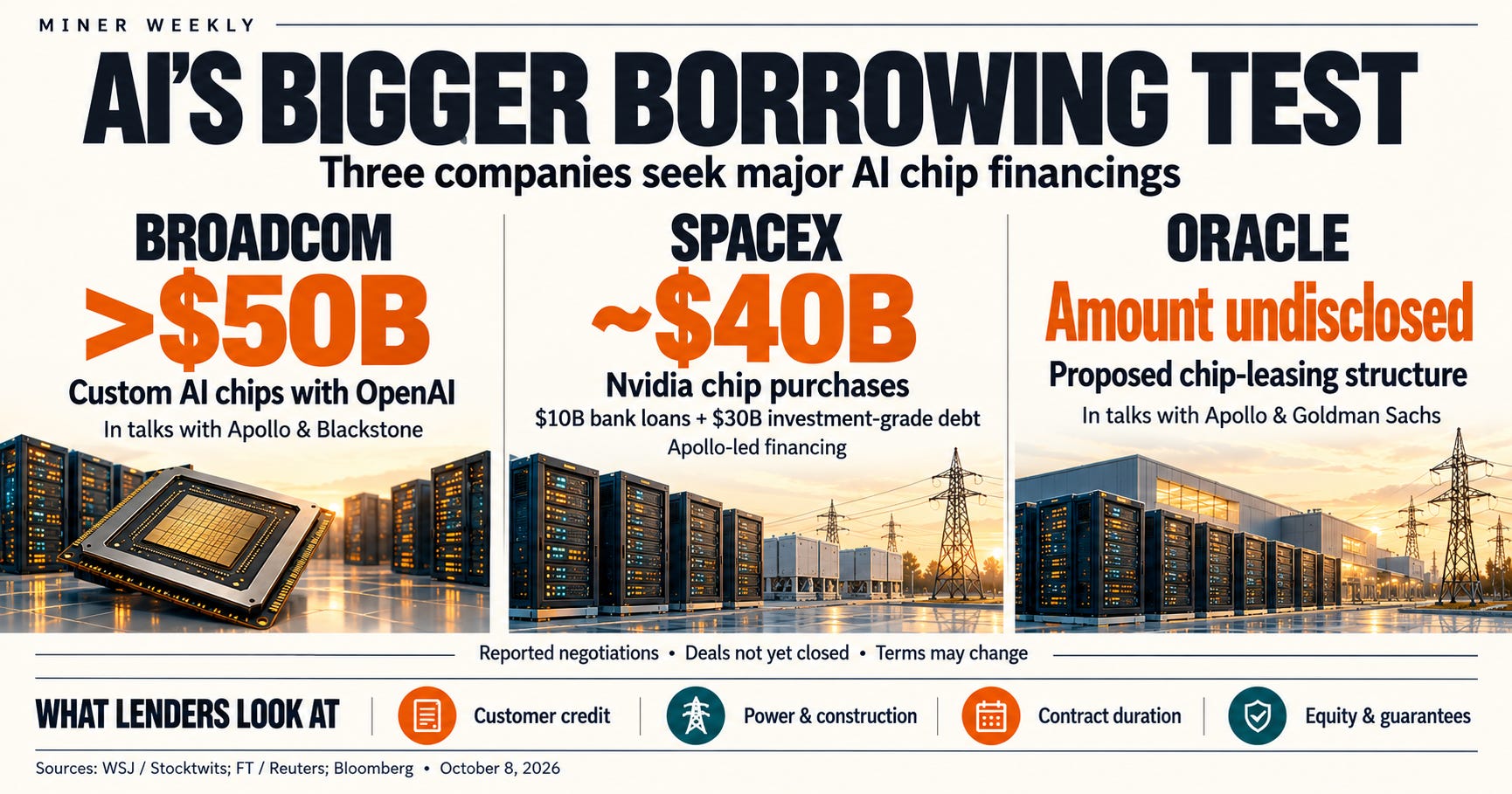
Buying chips for the AI boom is becoming a financing business of its own. On Tuesday, FT reported that SpaceX is looking to raise $40 billion to buy Nvidia AI chips, with $10 billion in bank loans and $30 billion in investment-grade debt.
Just one day later, WSJ reported that Broadcom has been working to arrange an even larger package at $50 billion for the custom AI chip it is developing with OpenAI. Meanwhile, Oracle is separately discussing chip financing with Apollo and Goldman Sachs. And interestingly, Apollo is involved in all three discussions.
While these talks remain preliminary and might not produce a deal, they come at an intricate time as big lenders have become more selective about data center loans and decisions increasingly depend on the customer, the contract and the path to completion.
Oracle’s Project Jupiter in New Mexico illustrates the scrutiny. Oracle’s force-majeure notice over potential power-related delays was prompting bankers and investors to reassess how development risks are allocated.
These reports suggest greater lender selectivity, although company disclosures show that substantial financing remains available. The differences between transactions are revealing.
IREN announced a $3.65 billion investment-grade GPU financing package on June 1 to support its Microsoft cloud contract, with a blended debt cost of 6%. In its August results, IREN disclosed a separate $2.4 billion financing at a 9% fixed rate for its Mackenzie air-cooled expansion.
The three-percentage-point gap is notable, though it can’t be treated as a like-for-like increase in IREN’s borrowing costs since the packages finance different exposures. But their terms demonstrate how widely the price of capital can vary within the same company.
They also highlight the need to distinguish equipment financing from funding for an entire development. A facility covering most GPU purchases does not automatically cover buildings, electrical infrastructure, construction contingencies and working capital.
CoreWeave’s disclosures show how the duration of customer contracts can introduce another financing consideration.
In March, the company announced an $8.5 billion non-recourse, investment-grade financing facility. Its floating-rate tranche carried a margin of 2.25 percentage points above SOFR, the benchmark borrowing rate, while its fixed-rate tranche cost approximately 5.9%.
An August $2.6 billion facility carried a margin of 5.5 percentage points above SOFR, a parent guarantee and a minimum debt-service coverage requirement of 1.35 times once testing begins. CoreWeave said the roughly five-year financing extended beyond the underlying customer contracts’ average three-year duration.
That maturity gap means the borrower may need to renew customers or find new users while debt remains outstanding. The higher margin and parent guarantee illustrate the price and obligations that can accompany more flexible financing.
Cipher Digital offers a counterpoint to any suggestion that the market has broadly closed. Its Stingray subsidiary priced $810 million of senior secured notes in June with a 6% coupon, issued slightly below face value. In August, Cipher said the completed offering funded Stingray through substantial completion and reimbursed some previously incurred project expenditure.
That is a concrete financing milestone: a specific development with funding secured through a defined stage. It gives investors more information than a headline capacity figure or prospective customer agreement.
Even then, the coupon captures only part of the economic bargain.
In Cipher’s separate Barber Lake transaction announced in September 2025, Google agreed to backstop $1.4 billion of Fluidstack’s lease obligations in support of project financing. In exchange, it received warrants representing approximately 5.4% pro forma equity ownership, subject to adjustments and potential cash settlement under certain circumstances.
Credit support helped make the project financeable, while giving Google participation in Cipher’s equity value. For shareholders, warrants, required equity contributions, parent guarantees and restrictions on project cash all belong alongside interest expense when assessing the cost of expansion.
Getting energy and compute infrastructure projects financed takes more than a compelling business case. It takes the right investors, developers, power providers and customers working together. That’s the thinking behind Energy Investors Forum (EIF) 2027, returning to Dallas on June 15–16. Building on an inaugural edition that brought together 300+ senior executives, we’re shaping the next forum around candid discussions, meaningful introductions and opportunities to turn conversations into business outcomes.
SpaceX’s proposed $40 billion financing will be an important transaction to watch: whether it closes, how it is priced and what protections investors obtain. Its scale alone cannot tell us what another developer will pay.
Interested in being part of EIF 2027?
Apply to speak
Apply for a complimentary institutional investor pass
Explore sponsorship opportunities
Secure tickets at the launch rate through November 30
Learn more at energyinvestorsforum.com
Regulation News
California Man Charged in $300 Million Nvidia AI Chip Smuggling Case
Google Told to Halt Work at Two Finnish Data Center Sites Pending Review
Hardware and Infrastructure News
Applied Digital Activates 75 MW of AI Infrastructure at North Dakota Campus
TeraWulf Expands Muskie AI Data Center Campus to 1 GW
Fortitude Plans $100M Purchase of Bitmain’s Next-Generation Zcash Miners
Google and Constellation Lock In 890 MW of New Nuclear for PJM
Applied Digital Secures Up to 1 GW Power Agreement for Finnish AI Data Center Expansion
DarkHorse Secures 50 MW Power with Hopkinsville Electric Plant Board
Black Hills Plans $1.8B Gas-Power Build for Google Data Center
Corporate News
Nscale Appoints Former Meta Executive Justin Osofsky as Chief Operating Officer
Amazon Pledges $1B to Data Center Communities, Ends Government NDAs
Nscale Appoints Former Comcast Executive Amy Banse to Board
NextEra Energy Reaches $15.5 Million Settlement in Shareholder Derivative Litigation
CoreWeave Enters India with 240 MW AdaniConneX Collaboration
Foundry CEO Colyer Steps Down as Bitcoin Pool’s Share Retreats
Financial News
SpaceX looks to raise $40bn to buy Nvidia chips
Applied Digital reports fiscal first quarter 2027 financial results
Oracle, Broadcom and SpaceX Seek Blockbuster Debt Deals to Pay for AI Chips
Feature
OP-ED: AI Infrastructure Starts at Home