


Texas Governor Greg Abbott has put another obstacle in the path of the data center boom President Donald Trump wants to accelerate.
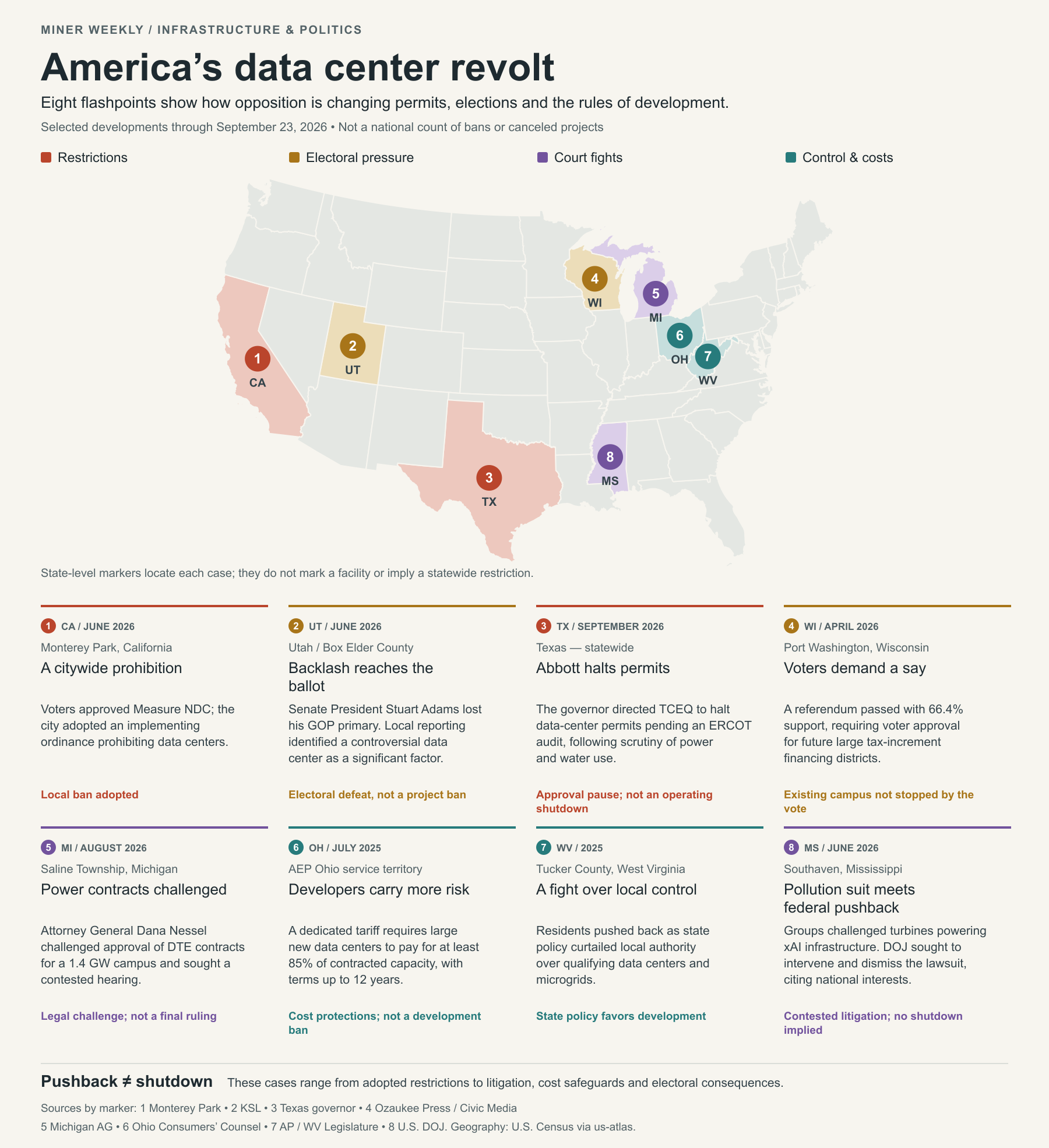
On September 21, Abbott directed the Texas Commission on Environmental Quality to halt permits sought by data centers until the state’s grid operator completes an audit. His directive also said state agencies should not advance related regulatory approvals before obtaining the information needed to assess the projects.
“Simply put, Texans must come first,” Abbott said.
The move followed an August directive requiring scrutiny of projects seeking connections to the Texas grid and a September crackdown on failures to report water use. Developers face questions about their electricity demand, cooling systems, tax incentives, ownership, and effects on surrounding communities.
In essence, a Republican governor is using state approvals to impose conditions on infrastructure that a Republican president has made a national priority.
Trump’s administration has sought to ease federal permitting and make federal land available for AI development. Its argument is that building computing capacity strengthens American economic and national security. Abbott’s directives reflect another political calculation: the communities supplying the land, electricity, and water want assurances about what they receive in return.
That tension is dividing the coalition behind the AI buildout. It is also expanding a conflict bitcoin miners already know well.
The opposition increasingly draws on concerns that fit comfortably within conservative politics: property rights, local autonomy, household bills, and distrust of large corporations.
Molly McCann Sanders, president of the Eagle Forum Education & Legal Defense Fund, illustrated the divide in a recent WIRED interview. A conservative Trump supporter who describes herself as a “crunchy MAHA mom” said she disagreed with the president on data centers and wanted development to proceed more cautiously.
Polling suggests that division reaches well beyond individual activists. A September New York Times/Siena survey found that 61% of likely voters opposed data center construction. Republicans were almost evenly divided, with 49% supporting construction and 47% opposing it.
Republican campaign advisers are responding. In a September memo reported by Axios, Trump pollster Tony Fabrizio warned that “unqualified support for building more AI data centers is a losing position.” His recommended approach emphasized enforceable protections for voters, rather than leading with promises about jobs or competition with China.
Utah offers evidence of the electoral stakes. State Senate President Stuart Adams lost his June Republican primary after becoming associated with a controversial data center proposal in Box Elder County. Local reporting identified the project as a significant factor in his defeat and those of two county commissioners, although the results cannot be attributed to a single issue.
The conflict extends beyond the Republican Party. Across states, residents and officials are disputing who has the authority to approve projects—and who can challenge the terms.
In Port Washington, Wisconsin, voters approved an April referendum requiring public approval for future tax-increment financing districts with project costs or a base value of at least $10 million. The measure followed controversy over financing for Vantage’s Lighthouse data center campus and passed with 66.4% support.
It did not stop the already-approved campus. It changed the rules for future financing decisions, giving residents a direct role in commitments previously made by local officials.
In Michigan, Attorney General Dana Nessel is challenging the utility commission’s approval of electricity contracts for a 1.4-gigawatt data center in Saline Township. Her appeal seeks a contested hearing, questioning both the approval process and the evidence supporting it. Those arguments remain legal claims, but the dispute shows how data center development can divide institutions within the same state.
West Virginia has taken a different approach. Its 2025 framework for certified microgrids and high-impact data centers curtailed local authority over qualifying developments, including restrictions involving noise, lighting, and zoning. The policy sought to attract investment, while communities around Thomas and Davis pushed back over their diminished influence.
The debate also follows developers beyond the electricity grid.
In June, the Justice Department sought to intervene and dismiss a lawsuit over gas turbines powering xAI infrastructure in Mississippi. The department argued that state authorities had determined no permit was required and invoked the facility’s economic and military importance. Community and environmental groups allege violations of air-pollution requirements.
The implication is uncomfortable for developers. Building dedicated generation may address concerns about drawing power from the grid, while introducing disputes over emissions, noise, and the location of power plants.
But there is an important distinction between the intensity of this political conflict and its effect on construction.
SemiAnalysis’s recent research counted more than 300 adopted local moratoriums and bans. Yet it estimated that only 1.525 GW of capacity was actually delayed by local restrictions, out of roughly 20 GW located within affected boundaries.
Its explanation was practical: many projects already held the necessary approvals, lay outside the jurisdiction imposing a restriction, or would not need the affected permit until after a temporary pause expired. Including New York’s intervention, the firm estimated about 2.3 GW of delays.
Those are proprietary analyst estimates, and the research predates Abbott’s September 21 permit halt. Yet, it provides a useful counterweight to the impression that every new moratorium removes another project from the construction pipeline.
However, political resistance can change the economics of development even when construction continues.
Ohio’s dedicated AEP data center tariff requires large new customers to pay for at least 85% of contracted capacity, with commitments extending up to 12 years. The framework aims to protect other customers from infrastructure costs associated with demand that fails to materialize.
The same argument has reached Congress. On September 16, the House passed the Ratepayer Protection Act, H.R. 9340, by 417–3, demonstrating overwhelming bipartisan support for addressing the infrastructure costs associated with large electricity users.
The bill would require state utility regulators to consider standards under which large-load customers pay the full incremental cost of the generation, transmission, and distribution infrastructure needed to serve them. There’s a catch: requiring regulators to consider a standard does not require them to adopt it.
The measure stalled the following day when Republican Senator Jon Husted of Ohio sought passage by unanimous consent. Democratic Senator Martin Heinrich of New Mexico objected that the protections were too weak, arguing that Congress should require data centers to pay for grid connections rather than leave adoption of the proposed standards to states.
Heinrich proposed his GRID Savings Act instead, but Republican Senator Bernie Moreno of Ohio blocked that request. The competing objections prevented expedited passage of either proposal; they were not Senate votes defeating the bills.
Trump’s administration has separately promoted a Ratepayer Protection Pledge, calling for developers to fund the energy and infrastructure their facilities require. The congressional impasse exposes the unresolved question behind that promise: how much protection should depend on corporate commitments and state decisions, and how much should federal law compel?
For communities facing new projects, a nearly unanimous House vote has yet to produce an enacted federal safeguard. For developers, the debate adds uncertainty over who will ultimately bear the costs of connecting their facilities to the grid.
Regulation News
Data Center Power-Cost Bill Stalls in Senate Over Enforcement Dispute
Pushback against AI data centers emerges as central issue in Michigan elections
Poway City Council unanimously advances AI data center ban
Virginia Curbs State Support for Large Data Centers, Plans Tighter Rules
Texas Governor Orders Data Center Permit Halt Pending Grid Review
Hardware and Infrastructure News
CleanSpark Names Meta as Tenant Behind $6.6 Billion Data Center Lease
Fluidstack Starts $4 Billion Texas AI Campus Phase Planned for 1.5 GW
New Era Energy Signs 207 MW Vistra Power Deal for Texas Data Center
Hut 8 Wins Poolin Auction With $140 Million Bid as AI Fuels Race for Power
Corporate News
Anthropic, OpenAI hunt for smaller data center deals in race to deploy AI capacity
GlobalFoundries, Marvell expand chip capacity deal for AI data center connectivity
Nscale’s IPO Filing Reveals $103B in AI Contracts with Heavy Funding Needs
Cypherpunk Names Amanda Fabiano to Board as Zcash Mining Commences
Nscale founder Joshua Payne in line for near $500m IPO pay day
TeraWulf CEO Moves to Monetize 3 Million Shares Tied to Land Lease
Financial News
Crusoe Secures $3.9B Series F at $30.9B Valuation to Scale AI Factory Operations
Oracle-Linked $18B AI Data Center Loans Come Under Pressure, FT Reports
Big Tech uses guarantees to keep $300bn of AI exposure off balance sheets
Fortitude Upsizes DCG Credit Facility to $50M, Plans $31M Draw in ZEC to Fund Hardware and Infrastructure Expansion