

The debate over slowing artificial intelligence has reached an industry that has already borrowed heavily to build for its acceleration.
Anthropic CEO Dario Amodei’s weekend proposal to pace frontier model development drew support from Sam Altman and Elon Musk, putting the speed of AI advancement under scrutiny from the executives driving it. Amodei explicitly distinguished pacing capabilities from halting model training or technical progress.
Investors nevertheless reassessed the infrastructure trade. The AI Infrastructure Growth Index tracked by TheEnergyMag plunged to 5,774 on Tuesday, down 9% since the market’s close on Friday before Amodei’s remark.
For public miners and AI infrastructure peers, the financial consequences turn on a different clock. The industry has raised and spent substantial capital against expectations of future AI demand. Money already spent cannot be recovered simply by slowing the next project. Interest on outstanding borrowing continues to accrue under its contractual terms, even if the revenue expected to service it takes longer to arrive.
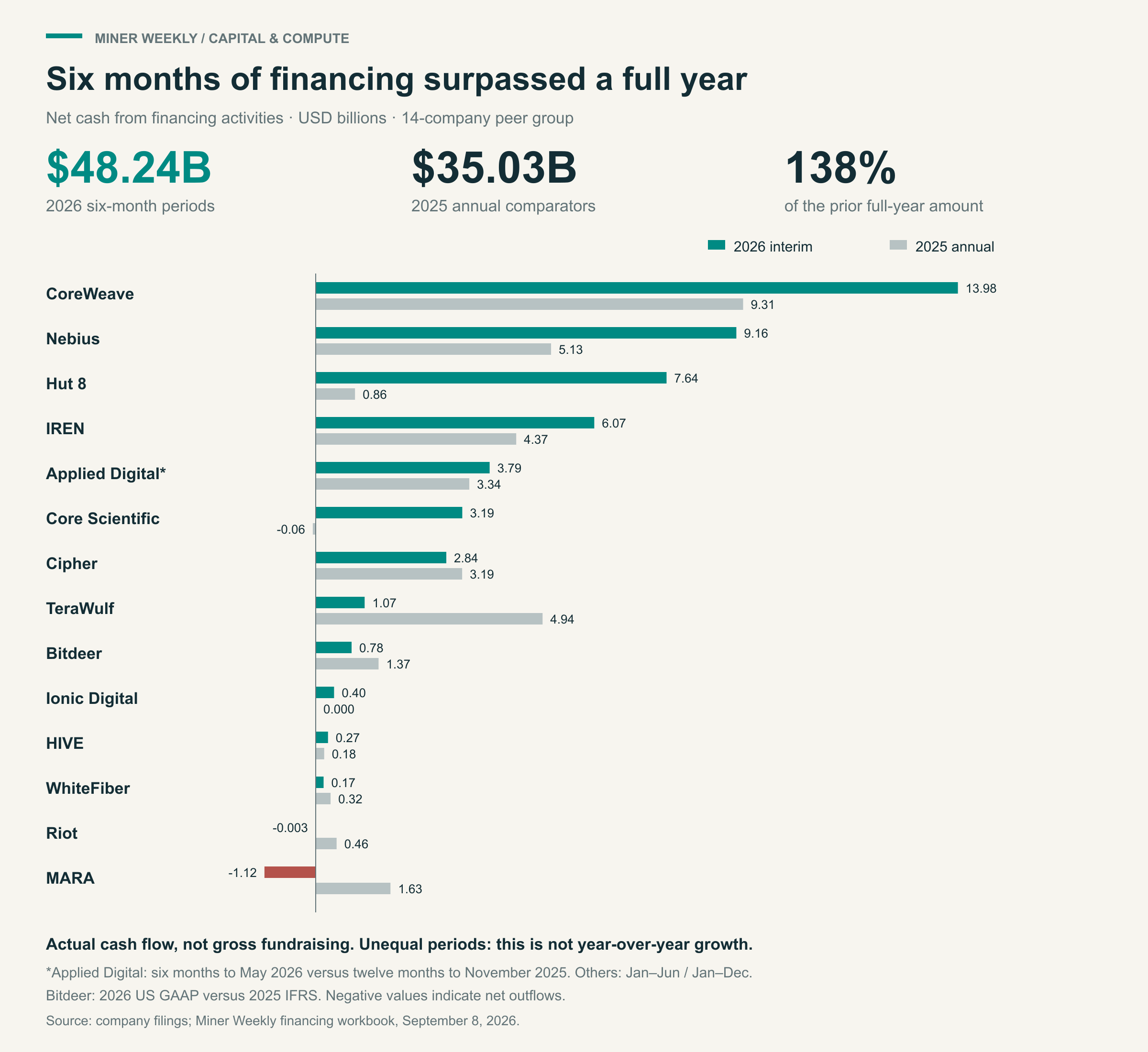
Fourteen companies tracked by TheEnergyMag generated $48.24 billion of net financing cash inflows in their latest six-month periods, exceeding $35.03 billion in the 2025 annual comparison periods. Net debt supplied $35.09 billion, or 72.7%, of that financing. Disclosed cash-interest payments reached $1.5 billion, despite gaps in reporting. The financing wave is concentrated. CoreWeave, Nebius, Hut 8 and IREN together accounted for roughly 76% of the net inflow.
A previous Miner Weekly issue examined the $30 billion capex already being committed to the buildout. Those expenditures have already occurred. Future projects can be deferred, but doing so does not erase existing debt or automatically release companies from signed construction and equipment commitments.

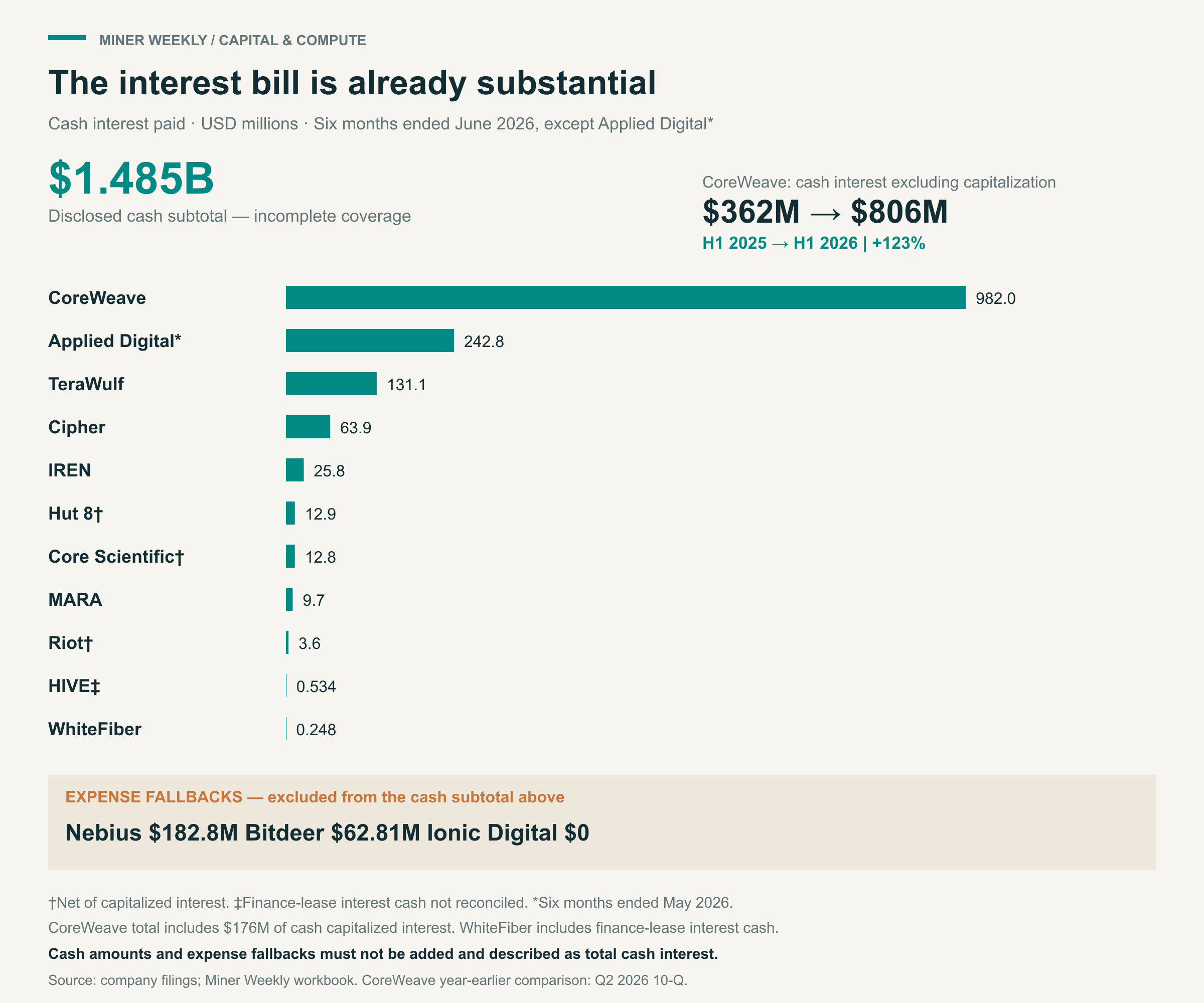
The carrying cost is already visible. CoreWeave paid $982 million in cash interest during the first half, including $176 million capitalized into assets. Excluding capitalized interest, payments more than doubled to $806 million from $362 million a year earlier. Applied Digital paid another $242.8 million during its latest six-month period.
Meanwhile, headline AI revenue does not always represent recurring income. Applied Digital’s $203 million in quarterly HPC Hosting revenue included just $44.1 million in base rent; most of the remainder came from tenant fit-out services. Construction-related revenue can be substantial before recurring rent reaches scale.
That distinction matters when assessing the cash available to service borrowing. Colocation providers need completed facilities to produce tenant receipts; cloud operators need installed GPUs to become billable usage and collections.
CNBC’s reporting this week put the potential consequences of an AI slowdown for the buildout under scrutiny. The financing risk can emerge before physical demand weakens: greater uncertainty about future cash flows could prompt lenders to demand more equity, stronger protections or higher returns on new funding.
The Federal Reserve has now added to the financing pressure, raising its benchmark target range by 25 basis points to 3.75%–4% on Wednesday. The unanimous decision cited elevated inflation and the need to return it to the central bank’s 2% goal. For AI infrastructure builders, the hike can increase costs on floating-rate debt as benchmarks reset and put pressure on new borrowing and refinancing, depending on market rates, loan terms and hedges.
A slower frontier does not necessarily mean declining compute demand. Existing models can keep attracting users, inference workloads can grow, and contracts can protect revenue. Future capex can also be deferred.
But with nearly three-quarters of this financing wave supplied by net debt, the industry has less room for revenue to arrive late. AI developers can debate the pace of advancement. Infrastructure owners still need to turn the capacity they have financed into cash.
Hardware and Infrastructure News
Global AI Wins Colorado Data Center Permit Amid Power, Water Disputes
Ethiopia Cuts Bitcoin Miners’ Power Supply as El Niño Hurts Dams
Wood County residents rally against Jon Husted as $800 million Meta data center rises near Bowling Green
Constellation agrees to purchase Rhode Island power plant from Shell for $715 million
Fluidstack Gets Site-Work Permit for $4 Billion Texas AI Data Center
Bitdeer Secures 65.1MW Malaysia AI Facility as Sales Pipeline Tops $7 Billion
Hut 8 Files $399 Million Building Project at Beacon Point AI Campus
Blockfusion Signs CoreWeave to 15-Year Niagara Falls Data Center Lease
Bitdeer Expands AI Infrastructure with Bhutan Agreement and Increased Bitcoin Output
Corporate News
Core Scientific Gets Conditional ERCOT Status for 1 GW at Texas Sites
Nebius Sued Over Alabama AI Land Deal Allegedly Costing Regions $66 Million
Sangha Texas Campus Gets ERCOT Base Load Status for 110.4 MW Plan
Soluna Says Dorothy’s 100 MW Gets Conditional ERCOT Base-Load Status
Cipher, Fluidstack and Anthropic Pledge $10M for Texas Town’s Water System
MARA’s 2 GW Texas Project Gets Conditional ERCOT Study Status
HIVE’s BUZZ Partners With ProCogia to Expand Canadian AI Services
Cipher Details Conditional Texas Grid Status for 3.2 GW of Projects
Financial News
Pentagon in Talks to Get Into AI Infrastructure Funding With a $5 Billion Loan
AI Stocks Slide as Anthropic Chief Calls for Slower Development
OpenAI Discusses Funding at $1.2 Trillion Valuation Ahead of IPO: Report
Wall Street weighs prospect of an AI slowdown on data center buildout
CleanSpark Plans $2.2 Billion Debt Sale for Georgia Data Center
CoreWeave Plans $3B Debt Sale, Opens 35 Million-Share ATM Program
Feature
In Virginia’s Data Center Hub, a County Fights to Reclaim Control