


Bitcoin’s second-quarter unplug looked like capitulation. It wasn’t.
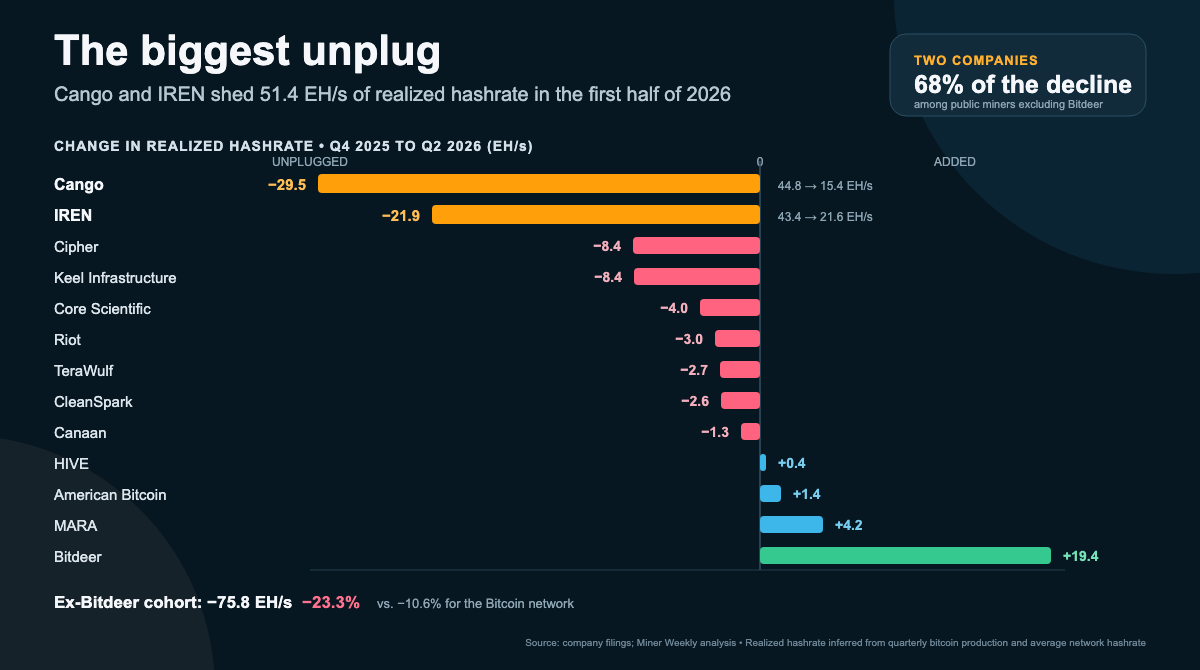
Public miners analyzed by TheEnergyMag shed an estimated 56 EH/s of realized hashrate over the first half of 2026—a 15% contraction compared to the 10% drop across the Bitcoin network. Much of that power was not leaving compute altogether. It was being redirected toward the AI retrofit.
The change has appeared in the income statement. Directly reported HPC and AI revenue among the comparable miners rose 52% from the first quarter. For the companies furthest into the transition, Q2 also marked the first time that HPC colocation or AI-cloud revenue overtook the mining revenue being wound down.
The conversion is expensive. A previous Miner Weekly analysis tracked roughly $30 billion of capex by public miners and AI peers. PwC now estimates that the broader AI data-center buildout could require $31.6 trillion through 2050.

The 14 companies in TheEnergyMag’s latest comparison spent $18.6 billion in one aligned quarter. Among the six infrastructure providers already reporting recurring HPC revenue, companywide capex was nearly 15 times their combined period revenue.
That spending-revenue gap leads to the question at the center of this issue:
What is an AI megawatt-hour actually worth—and how does it compare with digital mining compute right now?
For the six comparable AI power shell providers, TheEnergyMag estimated their recurring HPC revenue ranged from approximately $86 to $300 per MWh. The median was about $180.
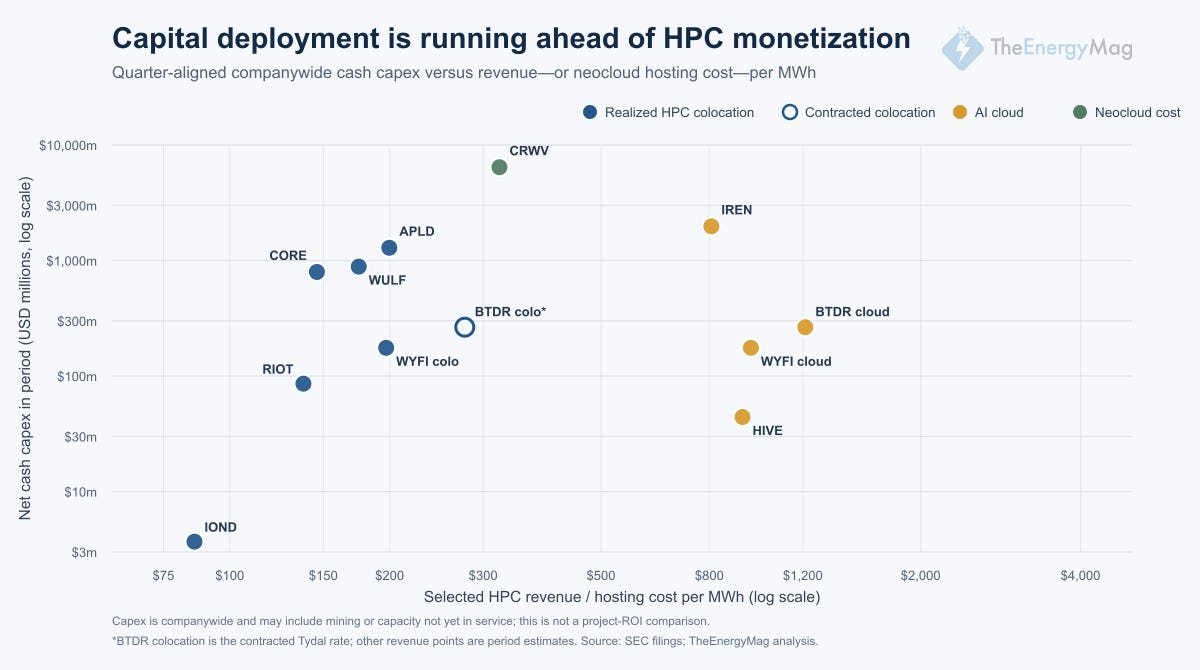
These figures divide recurring HPC, colocation or base-rent revenue by estimated billable megawatt-hours. Fit-out reimbursements and construction-related revenue are excluded where separable.
The estimates are sensitive to timing. A facility delivered halfway through a quarter cannot be treated as though it operated for all 91 days. Straight-line lease accounting may also recognize revenue before cash is collected.
Even with those limitations, the landlord-like models cluster in a relatively narrow range of approximately $140 to $200 per MWh.
The economics change when a company sells compute instead of powered space.
CoreWeave deployed $6.42 billion in the quarter. Based on its data center cost of revenue and estimated active power, we calculate that it was paying approximately $322 per MWh for hosting, with a range of $268 to $403 depending on the capacity-ramp assumption.
That cost includes more than the rent received by a data center landlord. It helps explain why a neocloud can spend more than $300 per MWh on infrastructure while a miner-turned-landlord initially recognizes only $150 to $200 per MWh.
Full-stack operators report still higher revenue. IREN produced an estimated $807 per MWh of AI-cloud revenue, HIVE approximately $924, WhiteFiber $958, and Bitdeer about $1,213.
Those figures are not comparable to rent. They include the value of GPUs, networking, software and orchestration. They also transfer utilization and hardware-obsolescence risk to the operator. Bitdeer demonstrates the distinction particularly well: its AI-cloud revenue density was the highest in the group, but the segment’s reported costs exceeded its revenue.
How it compares with mining
But still, AI cloud remains in a different revenue league. Its estimated median of $940.74/MWh is more than five times the $179.13/MWh generated by Bitmain’s latest-generation Antminer S23 Hyd. and more than eight times the $113.45/MWh from an S21 Pro.
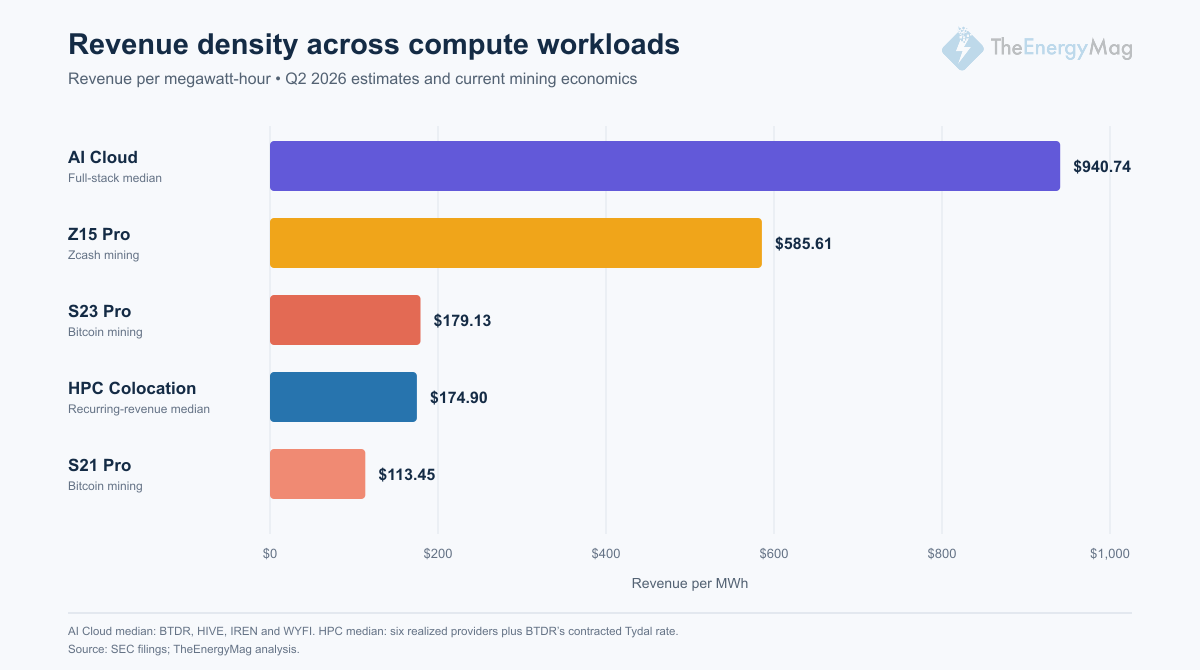
The more interesting comparison is between bitcoin mining and HPC colocation. TheEnergyMag’s estimated median of $174.90/MWh is almost identical to the S23 Hyd.’s current mining revenue. But the underlying economics are very different: colocation revenue is generally contracted for years and may pass electricity costs through to the customer, while bitcoin revenue changes continuously with bitcoin’s price, network difficulty and transaction fees.
Zcash mining sits between those extremes. A Z15 Pro—rated at 840 KSol/s and 2.78 kW—currently generates an estimated $585.61/MWh. That is roughly three times the revenue density of an S23 Hyd., although it comes with substantially greater volatility. Just a little over a week ago, the revenue was sitting at over $700/MWh for Zcash mining.


That makes Zcash mining temporarily more revenue-dense than most colocation agreements and competitive with lower-end GPU-cloud revenue.
But the word “temporarily” is doing considerable work. A miner can install ASICs quickly and sell production into a liquid market, but the revenue can fall overnight. An HPC campus can require years of capital deployment and construction, but a creditworthy tenant may then provide contracted payments for a decade or longer.
Revenue per MWh explains why miners want AI tenants. Capex explains why only some of them will create attractive returns.
Regulation News
Texas regulators approve two massive West Texas transmission lines amid outcry from landowners
Hardware and Infrastructure News
Nvidia Backs MediaTek With $3.5B in Expanded AI Chip Pact
Bitdeer AI Secures $800M in Offtake Commitments for Malaysia Data Center
Anthropic’s $35B Lambda Deal Connects Nvidia to Hut 8’s Texas AI Data Center
Bitdeer Acquires 200 Acres in Texas for $100 Million to Expand AI/HPC Infrastructure
AI Data Centers to Draw $31.6 Trillion Through 2050, PwC Says
Cipher Begins Pipeline Development for 2.5 GW On-Site Power Generation
Corporate News
Cango Targets Bare-Metal and Colocation Revenue at 3 MW Site Following Mining Optimization
Nscale Secures $3 Billion Debt Package for US AI Data Centers
NVIDIA Reaches $11.9 Billion Deal to Acquire AI Platform Hugging Face
Financial News
IREN AI Cloud ARR Hits $1B and Secures $2.8B in GPU Debt
Bitzero Repays $22.4M Loan as Nordic AI Data Center Plans Advance
Nvidia-Backed Nscale Touts $103 Billion Contract Book Ahead of IPO
Feature
Swedish Tax Scrutiny Shadows Crypto Miners’ Pivot to AI
This is the same lesson at two scales. Public miners are getting repriced around power access and AI/HPC options; home miners still need the smaller version of that checklist: wall watts, uptime, sustained hashrate, rejects/restarts, and current difficulty. The headline is never enough by itself.