

Today’s featured EIF speaker: Lisa Hough, who sits at the intersection of U.S. energy infrastructure, Bitcoin, and AI/HPC data center deployment. She brings institutional energy markets experience from Enron Capital & Trade, Phibro Energy, and PG&E National Energy Group, plus digital asset and regulatory expertise from Unchained and Custodia Bank, and is currently involved in structuring large-scale AI infrastructure initiatives including a roughly 2 GW campus in West Texas.
EIF Dallas (July 23-24) is a high-signal, curated conference convening leaders across energy, compute infrastructure, and capital to map the next decade of power and data center buildout.
Apply to speak or explore sponsorships for private meeting rooms, branding & more.
For much of the past halving cycles, bitcoin miners paid a steep premium to access debt markets—from high single-digit to high double-digit interest rates tied to volatile mining cash flows.
That premium appears to be now compressing.
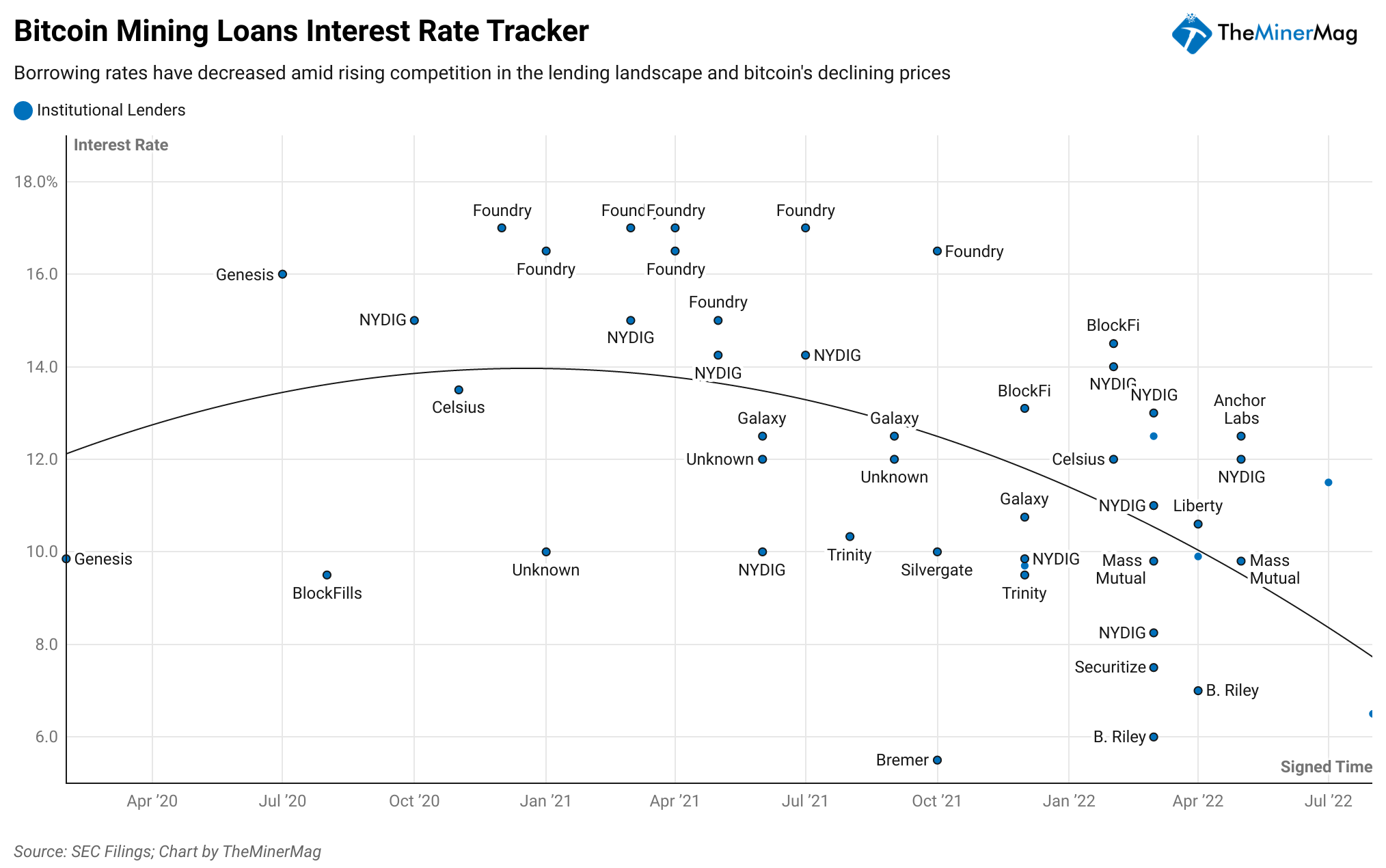
A wave of project-backed financings tied to AI and high-performance computing (HPC) shows borrowing costs moving decisively lower. Deals that cleared above 9% in 2025 are now landing closer to the 6%–7% range in 2026, according to recent bond offerings across Core Scientific, Cipher Digital, Applied Digital, Hut 8 and more.
At the same time, bitcoin-backed financing is repricing lower too, with Riot Platforms recently cutting its effective borrowing cost to ~6% and Hut 8 refinancing its Coinbase credit with a new deal from FalconX to slash the cost from 9% to 7%.
This isn’t just better market conditions. It’s a repricing of the underlying collateral.
Then: ASICs, Volatility—and Double-Digit Risk Premiums
To see how far the market has moved, it helps to look back at the last cycle.
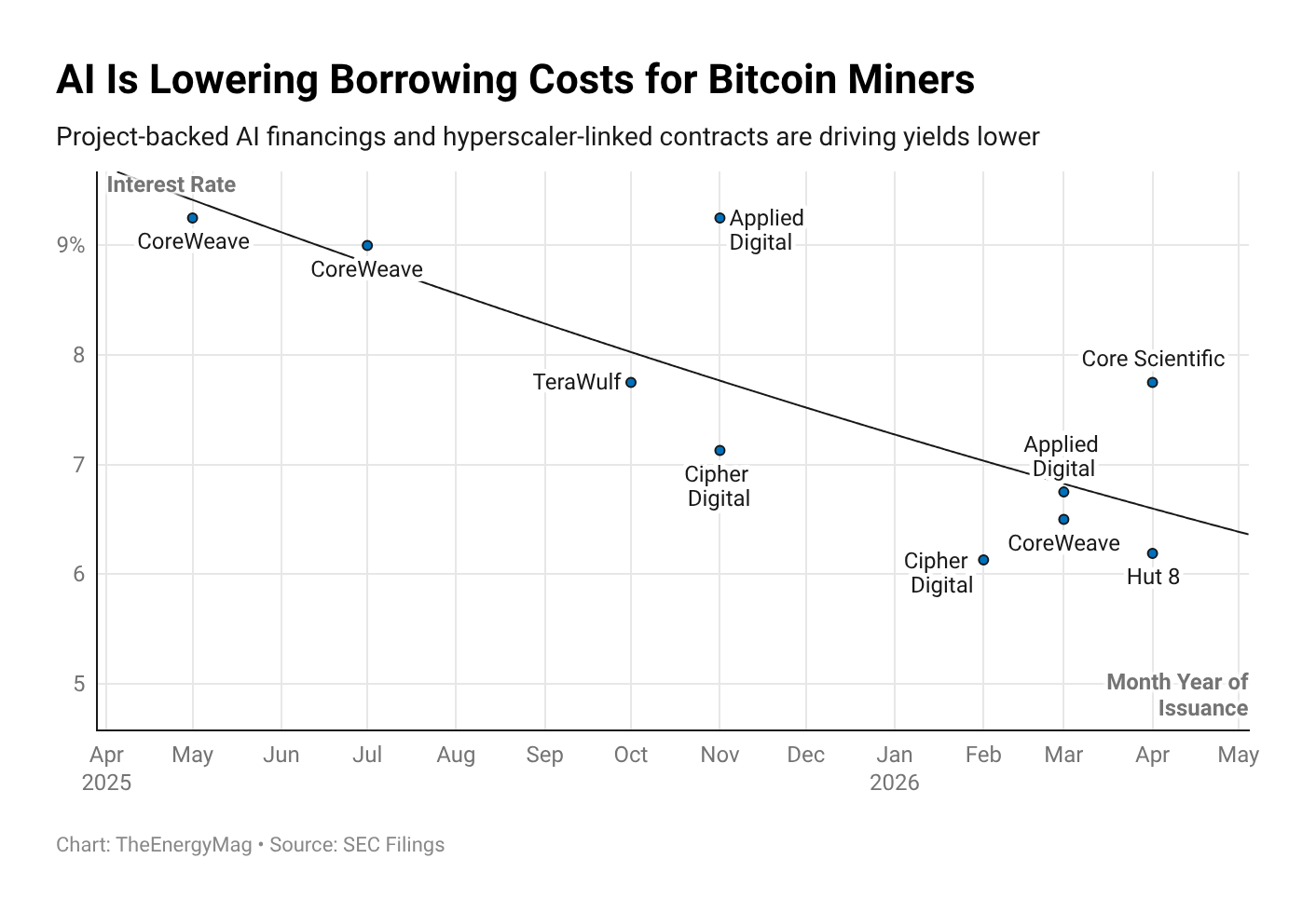
In 2021–2022, most mining debt was backed by Bitcoin ASIC machines—a collateral base that was highly cyclical, sensitive to bitcoin price and network difficulty, and prone to rapid depreciation.
The result: borrowing costs that routinely sat in the 12%–16% range, with some deals even higher depending on lender and structure. Lenders like Genesis, BlockFi and Celsius dominated the space, extending credit against rigs and bitcoin holdings in what was effectively a crypto-native shadow banking system. It worked—until it didn’t, and dragged big lenders underwater altogether when bitcoin prices fell and liquidity tightened in 2022.
Now: Contracted Compute Is Replacing Machine Collateral
Fast forward to today, and the collateral has fundamentally changed.
Instead of ASICs, lenders are underwriting long-term AI compute contracts, colocation leases with escalators and power-secured data center infrastructure.
That shift moves the credit profile away from commodity exposure and toward infrastructure-style cash flows.
CoreWeave’s trajectory is emblematic—moving from ~9% financing in 2025 to the low-6% range, supported by contracted revenue and investment-grade positioning.
Miners making the AI pivot are now being evaluated less like speculative operators—and more like emerging data center credits.
The Spread Tells an Interesting Story
Even as headline rates fall, dispersion remains notably—and increasingly informative.
From TheEnergyMag’s chart above:
CoreWeave: low-6% range
Hut 8: low-6%
Cipher Digital: down from low-7% to low-6%
Applied Digital: down from low-9% to high-6%
Core Scientific: still pricing at high-7%
One of the key developments over the past year is the emergence of hyperscaler-linked credit support.
Hut 8, Cipher and TeraWulf have disclosed that Google provides financial backstop mechanisms tied to Fluidstack’s lease obligations—effectively anchoring those projects to hyperscaler demand.
That support matters and has helped pull borrowing costs into the mid- to high-single-digit range, tighter than what miners would achieve on a standalone basis.
This dynamic is clearest in the spread between Core Scientific and Hut 8. Both raised capital against AI infrastructure at roughly the same time with credible counterparties (Core Scientific with CoreWeave and Hut 8 with Fluidstack backed by Google). Yet Core Scientific continues to pay more.
AI Is Doing What Bitcoin Couldn’t
For years, miners argued they were infrastructure businesses. Markets didn’t buy it—because the collateral didn’t support the claim.
AI changed that.
With hyperscalers expected to spend roughly $700 billion on AI infrastructure this year, compute capacity has become a strategic asset. Power, land and interconnection—long the domain of bitcoin miners—are now in short supply.
Miners—who spent a decade building in exactly those constraints—are now being re-rated accordingly.
Hardware and Infrastructure News
Riot Expands AMD Deal to 50 MW, Cuts Coinbase Loan Rate to 6.15% in AI Push
IREN Rallies 11% on Sweetwater Energization Milestone Amid AI Power Race
Peter Thiel Leads $140 Million Series B for Panthalassa’s Ocean-Powered AI Infrastructure
Nscale Expands Microsoft AI Deal With 66,000 Rubin GPUs in Portugal
Soluna Closes $53M Wind Farm Acquisition and Reports April 2026 Operational Progress
American Bitcoin Secured Bitmain Miners at Implied 44% Discount Using BTC Collateral
Corporate News
$70B Investor Coatue Expands Into AI Data Center Land Grab
IREN to Acquire Mirantis in $625M Deal to Expand AI Cloud Software Stack
Applied Digital Completes AI Cloud Spinout Into New Nasdaq Firm ChronoScale
Nine Texas residents sue MARA, expanding Granbury bitcoin mine noise fight
Core Scientific Reveals $232M Texas Acquisition, Sold 2,385 Bitcoin to Fund AI Expansion
Hut 8 Surges to All-time Highs After Landing Second AI Data Center Lease Worth $9.8 Billion
Financial News
Microsoft Committed $7 Billion Upfront in Nebius AI Deal
Hut 8 Refinances Bitcoin-Backed Credit Facility with $200 Million FalconX Deal
Applied Digital Secures $300 Million Bridge Loan for North Dakota AI Data Center
Cipher Secures $200M Credit Line as Amazon AI Retrofit Cuts Bitcoin Hashrate
Solaris Energy Prices $1.3B Notes at 6.375% as AI Power Buildout Accelerates