

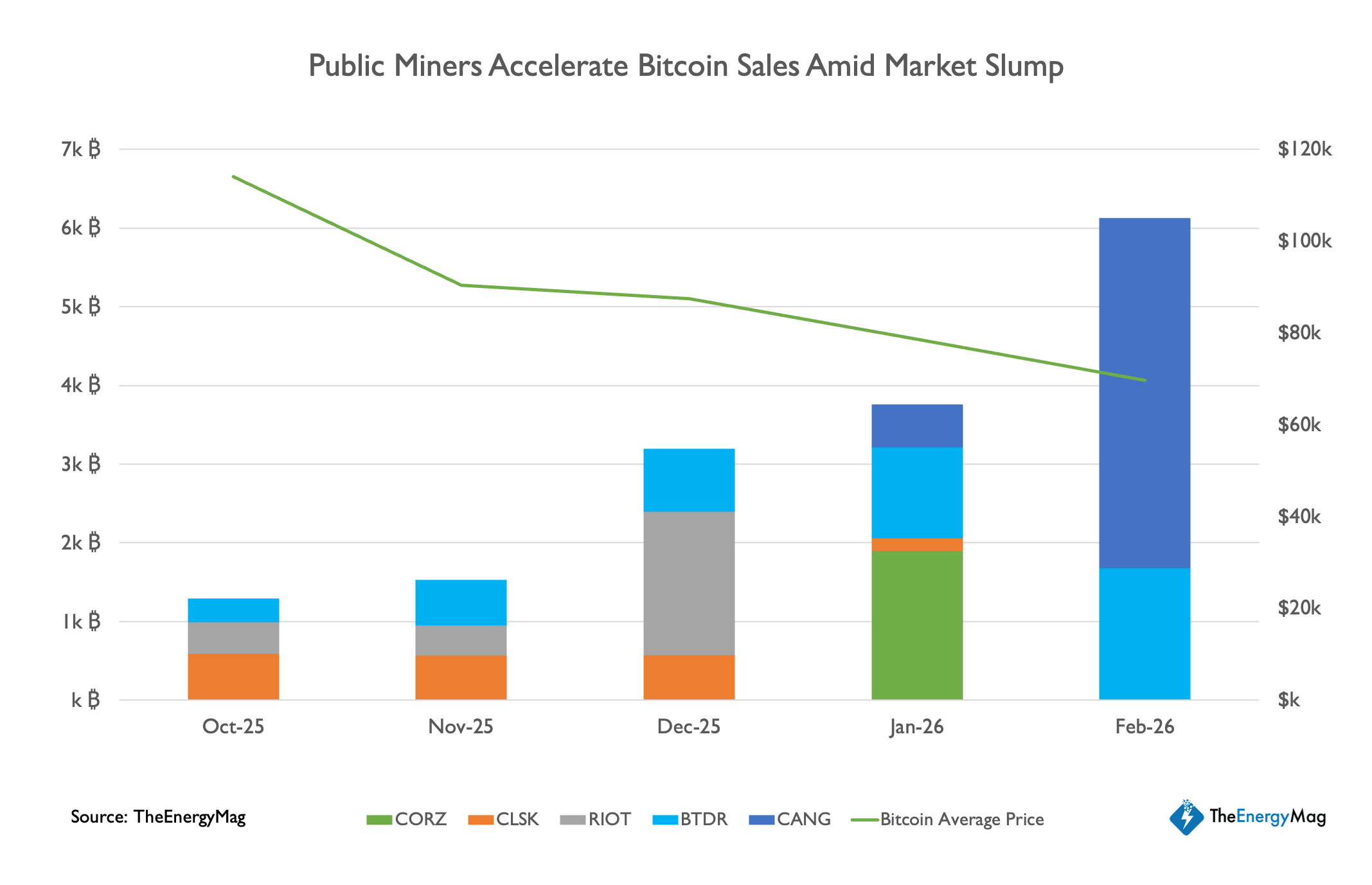
It’s not news that public mining hodlers have been selling coins for months. Riot liquidated four times its production in December; Cango sold 4,451 BTC in February, or 60% of its reserves; and Bitdeer cleared out its bitcoin reserves last month.
But the latest round of annual filings this week suggests the pace may be accelerating — and could get even more turbulent ahead.
Fresh disclosures from several mining companies indicate that treasury liquidations picked up sharply after Bitcoin’s post-October slide squeezed margins and pushed mining economics below breakeven. Together, they sold more than 15,000 BTC in five months.
Over the past week, Core Scientific revealed in its latest annual report that it plans to sell all of its roughly 2,500 BTC holdings in the first quarter, with 1,900 BTC already sold in January.
Riot noted that bitcoin’s downward trend "may necessitate the sale of a greater volume" of its bitcoin than previously anticipated, to maintain the liquidity required for ongoing operations and working capital
Even MARA — historically one of the industry’s most aggressive Bitcoin accumulators — has softened its stance. While the company still held more than 53,000 BTC at the end of 2025, it has adjusted its treasury policy to allow sales beyond just newly mined coins.
In other words: the HODL era is quietly loosening.
Miners Are Selling Into a Profit Squeeze
The selling pressure shouldn’t come as a surprise.
Since October, Bitcoin’s average price has slid steadily, pushing mining economics into uncomfortable territory.
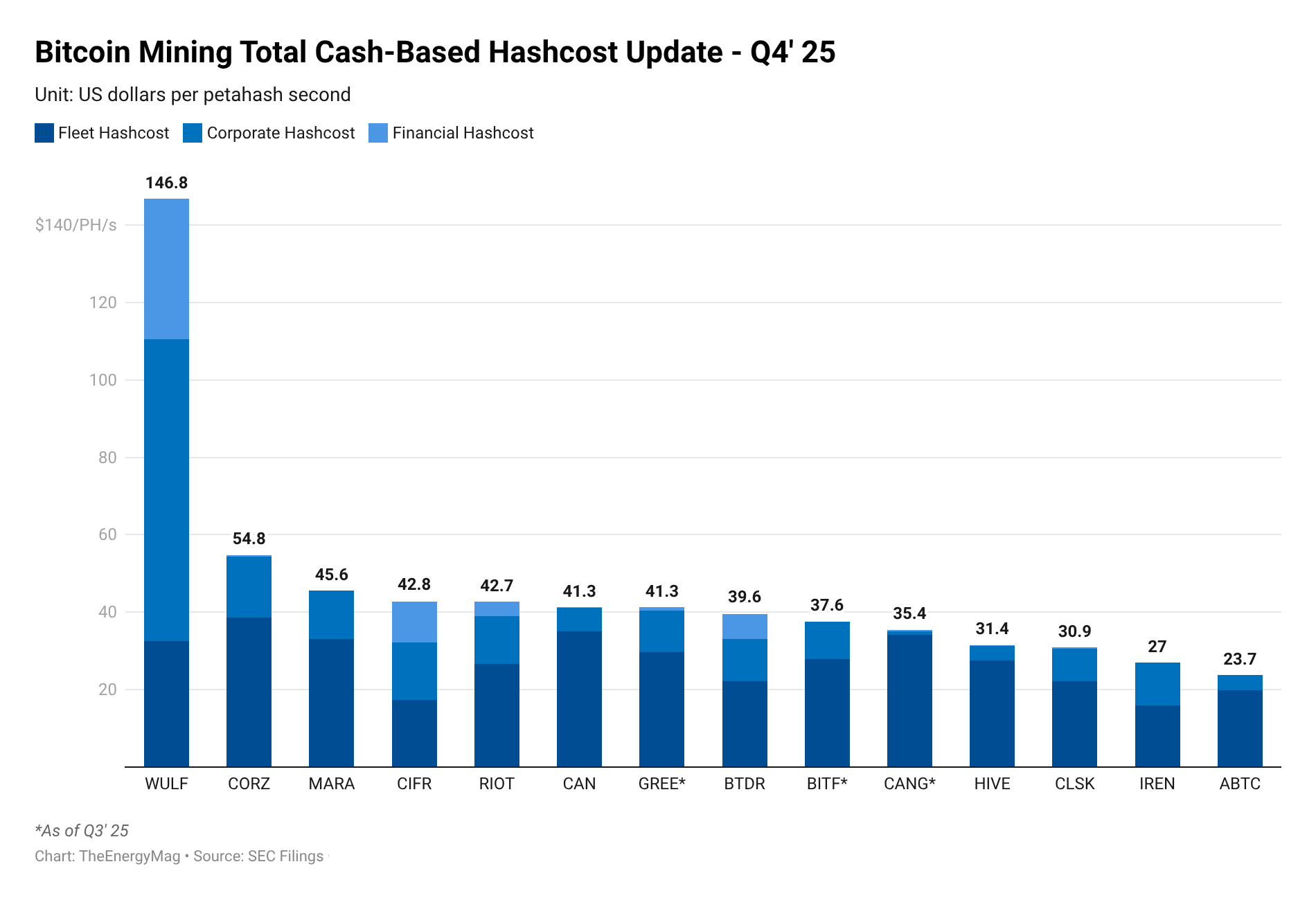
Hashprice — the key profitability metric for miners — recently fell below $30/PH/s, a level below the total cash-based hashcost for most public miners, according to TheEnergyMag’s analysis of the latest quarterly filings.
In simple terms: many miners are currently operating at or below breakeven.
The gap between hashprice and hashcost has historically been one of the strongest triggers for treasury liquidation.
And the numbers are starting to show it.
Debt Is Rising — and Bitcoin Is the Collateral
Unlike previous downturns, many public miners entered 2025 with significantly more leverage.
Across the industry, companies tapped credit facilities, Bitcoin-backed loans, and senior secured bonds to fund both operating costs and the massive buildout of AI and high-performance computing (HPC) data centers.
That leverage often comes with Bitcoin collateral requirements.
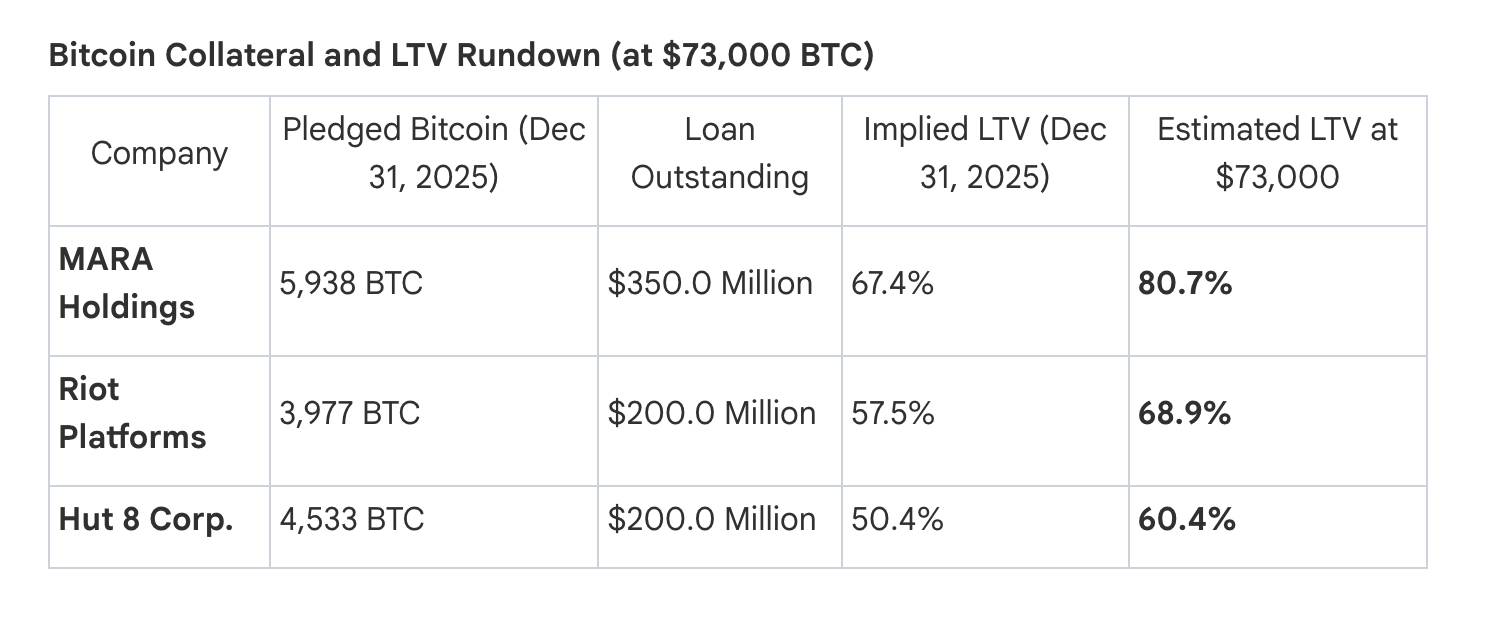
As of Dec. 31, three major miners — Hut 8, MARA and Riot Platforms — had pledged more than 14,500 BTC combined against loans.
The catch: as Bitcoin prices fall, loan-to-value ratios rise.
With Bitcoin dropping sharply after the new year, these collateral ratios likely increased — meaning additional Bitcoin may already have been pledged to maintain lending thresholds, which are typically set at around 60%.
A Classic Miner Capitulation Signal?
Historically, large-scale miner selling has often coincided with late-stage bear market conditions.
When margins compress and treasuries shrink, weaker miners exit and stronger operators consolidate — setting the stage for the next recovery.
Whether this cycle follows the same pattern remains uncertain.
Bitcoin has already rebounded to around $73,000, lifting hashprice back above $30/PH/s.
But that recovery hasn’t fully restored mining profitability. For most public operators, cashflow remains tight.
Which leaves the industry in an unusual position:
Miners are almost simultaneously selling Bitcoin to survive the present while borrowing aggressively to build AI infrastructure for the future.
If history is any guide, miner capitulation has often marked the end of painful market phases.
But for now, the industry is still very much in the middle of the squeeze.
Regulation News
Russian Draft Notices Issued to Chinese Digital Asset Workers
U.S. Nuclear Regulatory Commission Publishes Proposed Rule and Guidance for Fusion Regulatory Framework
Hardware and Infrastructure News
American Bitcoin to Add 3 EH/s With New S21XP Purchase, Reactivating Drumheller Site
IREN Expands AI Cloud Capacity to 150,000 GPUs
Corporate News
MARA and Starwood Form Strategic Partnership to Develop 2.5 GW AI Infrastructure Platform
TeraWulf CEO Sets Plan to Sell 1.65M Shares Amid $3.2B AI Pivot
Core Scientific Sold 1,900 BTC in January; to Sell Remaining Bitcoin in Q1
MARA Expands BTC Sales Flexibility After Mixed 2025 Bitcoin Treasury Results
Canaan Announces Open Market Share Purchases by CEO NG Zhang and CFO
Financial News
OpenAI Secures $110 Billion in New Funding to Fuel Global AI Scaling
Blackstone to Launch Public Entity for AI Data Center Investments
Applied Digital Targets $2.15B Bond Sale for North Dakota AI Data Center
Core Scientific Lands $500M Loan at ~7.8% as AI Data Center Financing Boom Continues