

Today’s featured EIF speaker: Joshua "JP" Buzzell, Executive Vice President of Engineering at Bitdeer, where he bridges the physical and logical layers of the digital economy. A recognized leader in data center architecture, JP’s career spans hyperscale infrastructure, OEM leadership, and high-reliability nuclear operations, including prior leadership roles at Eaton, Oracle, and Meta, plus U.S. Navy nuclear experience that informs his approach to gigawatt-scale data center builds.
EIF Dallas (July 23) is a high-signal, curated conference convening leaders across energy, compute infrastructure, and capital to map the next decade of power and data center buildout.
Get your tickets today and use code MNRW30 for 30% off exclusively for Miner Weekly subscribers. You can also explore sponsorship opportunities to elevate your brand and connect with leaders across energy, infrastructure, and capital.
There are moments in proof-of-work mining when the market briefly reminds everyone that electricity is not tied to a single digital asset, or even a business model.
The same megawatt can secure bitcoin, mine Zcash, chase Kaspa rewards or support an AI/HPC workload. Which one makes the most sense increasingly depends less on ideology than on a moving set of prices: token values, network difficulty, machine efficiency, hosting rates and power costs.
For the past year, public-market investors have largely rewarded the AI side of that equation. Bitcoin miners with large power portfolios have been repriced on the idea that their sites may be more valuable as data center infrastructure than as pure mining operations.
But Zcash’s rally, after years on the sidelines, has complicated that narrative.
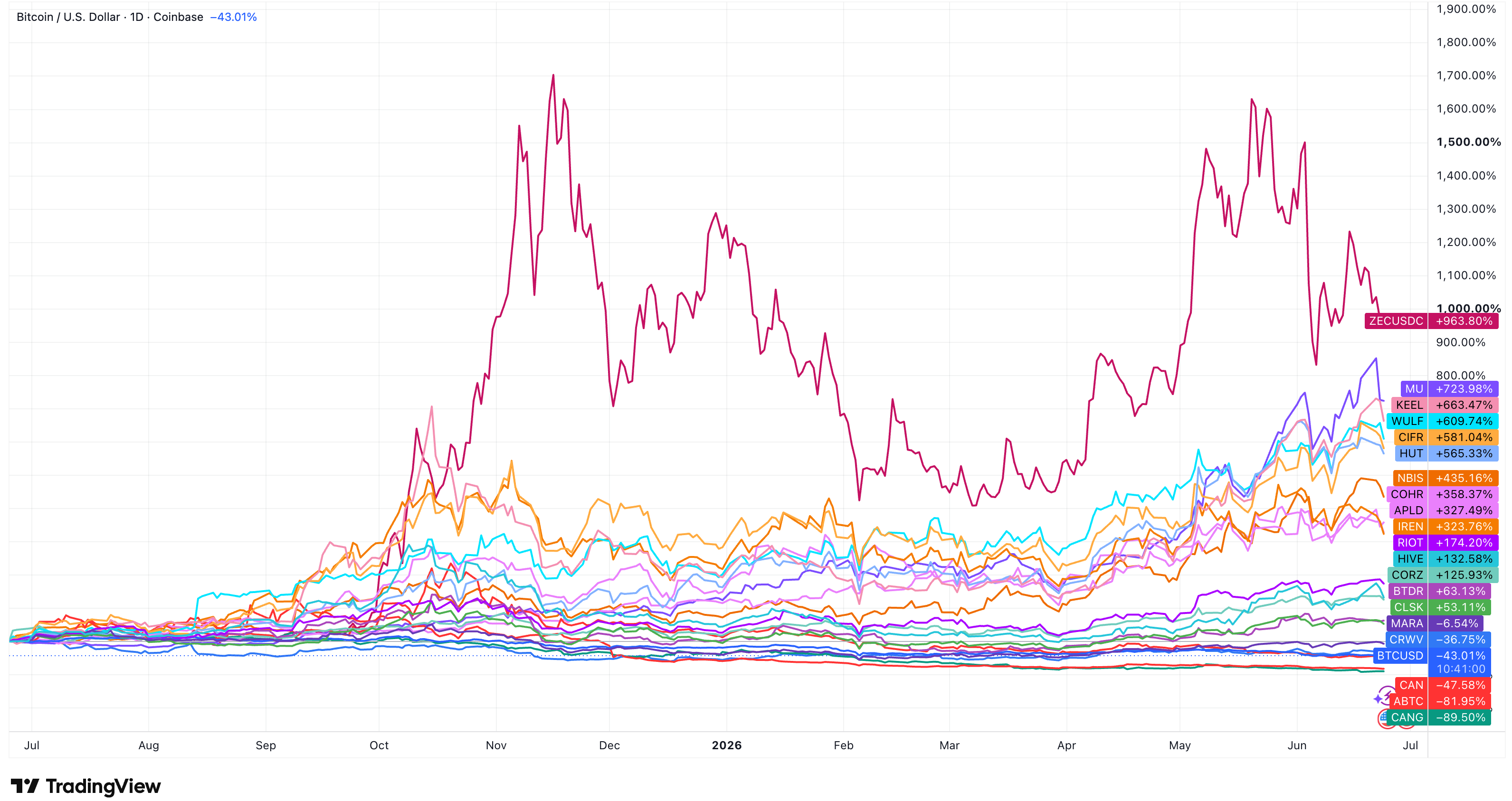
The price appreciation of ZEC since late last year, followed by renewed hashrate momentum on the network, has made Equihash mining economics suddenly relevant again. In some cases, the revenue per unit of power now compares favorably not only with other proof-of-work assets, but also with estimated HPC colocation economics.
That backdrop helps explain why Fortitude Mining’s plan to go public is arriving at an interesting time.
Fortitude, a Zcash-focused digital asset mining platform under Digital Curreny Group, announced this week that it plans to list on Nasdaq through an all-stock merger with HeartSciences. The proposed company would operate under the Fortitude brand and is expected to trade under the ticker TUDE, subject to Nasdaq approval.
The transaction is still light on detailed financial disclosure. But Fortitude has released enough operating data to make the broader point clear: this is not just another crypto miner trying to attach itself to the AI trade. It is a test of whether public investors still have an appetite for a crypto-native compute business when the economics of a non-bitcoin proof-of-work network suddenly improve.
A Revenue-per-Megawatt Lens
TheEnergyMag’s latest analysis compares revenue across several proof-of-work mining rigs and a conservative estimated HPC colocation benchmark on a common basis: dollars per megawatt-hour.
The result is a useful snapshot of the compute market’s current hierarchy.
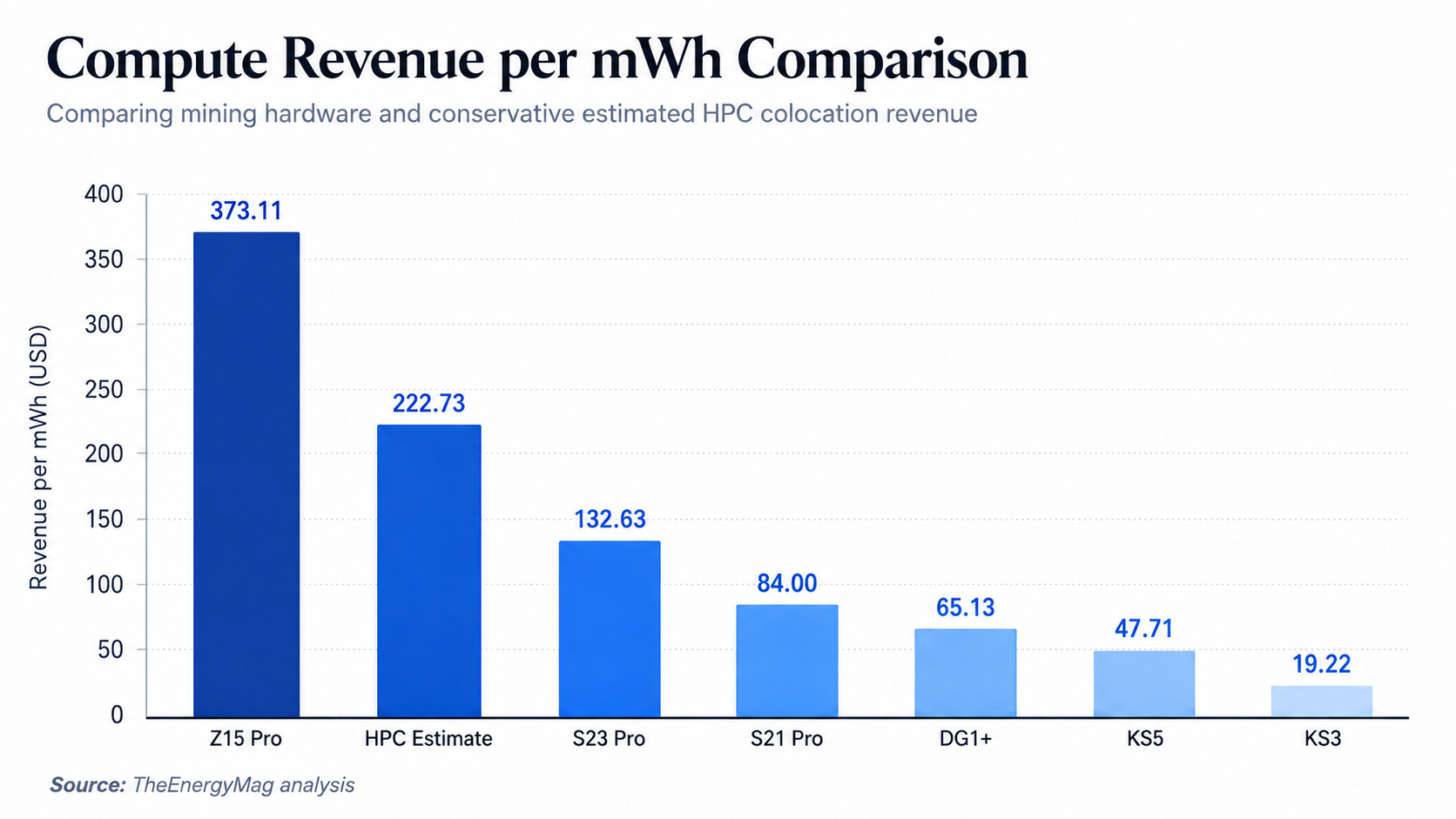
On the high end, a Zcash-focused Z15 Pro generates an estimated $373 per MWh, far above the $223 per MWh conservative estimate for HPC colocation. A next-generation bitcoin miner, the S23 Pro, comes in at about $133 per MWh, while the S21 Pro produces roughly $84 per MWh. By comparison, the DG1+ and Kaspa-focused KS5 and KS3 models generate about $65, $48 and $19 per MWh, respectively, under the assumptions used in the analysis.
That spread matters because it cuts through the usual framing of bitcoin mining versus AI infrastructure. The more precise comparison is not crypto versus AI. It is compute revenue versus power cost, with different machines and workloads competing for the same scarce input: electricity.
Over the past year, the dominant market narrative has been that bitcoin miners should redirect power toward AI and high-performance computing whenever possible. That logic is easy to understand. AI demand has created a scarcity premium for energized land, grid interconnection rights and large-scale power capacity.
But the revenue comparison shows the decision is not always straightforward.
HPC contracts may offer longer duration, lower volatility and stronger visibility than mining, provided that the business development and execution process is done well. That makes them attractive from a financing perspective, especially for public companies trying to reduce dependence on daily crypto-market swings.
Mining, however, retains optionality. When a proof-of-work asset rallies substantially faster than its network difficulty adjusts, mining revenue can temporarily exceed what infrastructure owners might earn from contracted HPC hosting.
Zcash is currently an example of that dynamic. Zcash has historically occupied a smaller niche than bitcoin, with less liquidity, fewer institutional narratives and a narrower base of industrial-scale miners. But the recent ZEC price rally has changed the revenue math for Equihash ASICs.
That does not mean Zcash mining is more valuable than HPC infrastructure on a risk-adjusted basis. Just search Zcash’s price crash and fast rebound earlier this month. Nonetheless, it perfectly shows that crypto-native compute can still produce bursts of exceptional returns, particularly in smaller networks where price and hashrate can move out of sync.
That creates both opportunity and risk for companies like Fortitude. A Zcash-focused platform may enjoy stronger near-term mining economics when ZEC outperforms, but it is also more exposed to the market volatility and the speed at which network difficulty can adjust and erode those gains.
Fortitude’s Timing
Fortitude’s public-market plan lands directly into that debate.
The company has not yet released detailed financials, leaving investors without a full view of its revenue, cost structure, power contracts or margins. But the operating metrics it has disclosed suggest it is not a small exploratory Zcash operation.
Fortitude said it began mining ZEC, the native token of the Zcash network, in 2019 and has since scaled production to an annualized run rate of 157,000 ZEC. Based on ZEC’s current price of about $400, that production rate implies a static annualized revenue of about $62 million.
Either way, the disclosed production rate gives Fortitude a meaningful operating base in a network that remains far smaller than bitcoin but has recently become more economically attractive for specialized miners. The timing is important: ZEC’s price appreciation has improved mining revenue for Equihash ASICs, while rising hashrate suggests more machines are being pointed at the network to capture those returns.
That dynamic gives Fortitude a more differentiated story than public bitcoin miners that are increasingly trying to convince investors their megawatts can be repurposed for AI. Fortitude is entering the market as a crypto-native infrastructure company with direct exposure to Zcash economics.
That identity may help it stand out, but it also narrows the questions investors will ask. Without detailed financials, the key issues will be how much of Fortitude’s revenue depends on current ZEC prices, how quickly network difficulty is rising, what its power costs look like, and whether its fleet can remain competitive as more Equihash capacity comes online.
In that sense, Fortitude’s planned listing could become a useful public-market test case for non-bitcoin proof-of-work exposure. If Zcash economics remain strong, the company may find investor appetite for a miner tied to a differentiated asset. If margins normalize quickly, the listing may instead reinforce how difficult it is for crypto-native miners to turn cyclical revenue spikes into durable infrastructure value.
Regulation News
US to Fast-Track AI Data Centers as Power Bottleneck Becomes National Priority
Texas Regulators Approve ERCOT Batch Process for AI Data Center Power Requests
Thailand seeks to arrest fugitive Chinese businessman over illegal crypto mining
Hardware and Infrastructure News
Microsoft to Build 2GW AI Data Center Campus in West Texas With Onsite Gas Power
Constellation, Walmart Sign Nuclear Power Deal for Illinois Supply Chain Expansion
Bitzero Adds Finland Land Reservation to Nordic AI Data Center Pipeline
Galaxy Digital Advances $400 Million AI Data Center Plan in McGregor, Texas
Sphere 3D Signs 30 MW Bitcoin Co-Mining Deal With Bitdeer
Corporate News
Hut 8 Investors Reach $2.35 Million Settlement Over US Bitcoin Merger Claims
Riot CEO Sells Another $7M as Bitcoin Miner Briefly Tops $30 on AI Rally
DOE Announces $17.5 Billion Loan Commitment to Revive American Nuclear Supply Chain
CoreWeave Expands Swedish Presence with Conapto Data Center Deal
Bitcoin Miners Move to Defend Exchange Listings as Sub-$1 Shares Persist
Financial News
DCG’s Fortitude Mining to Go Public Through HeartSciences Merger
Cerebras Systems Reports Q1 2026 Revenue of $193.4 Million
HIVE Lines Up Swedish AI Lease as It Seeks $100 Million Note Offering
Feature
EIF Speaker Series: ‘AI’s Real Buildout Has Barely Begun’ with NG Zhang
EIF Speaker Series: ‘Inference Could Shift the AI Compute Mix’ with Paul Golding