


Three months ago, we examined how public bitcoin miners were beginning to dismantle or repurpose mining fleets for AI and high-performance computing infrastructure.
The analysis found a notable redistribution beneath an apparently stable aggregate: Core Scientific, IREN, Cipher Digital, TeraWulf and Keel Infrastructure were giving up bitcoin production, while Bitdeer, MARA, Riot Platforms and American Bitcoin absorbed much of the displaced network share.
At the time, the system remained roughly balanced.
The second quarter earnings suggest that balance is beginning to break.
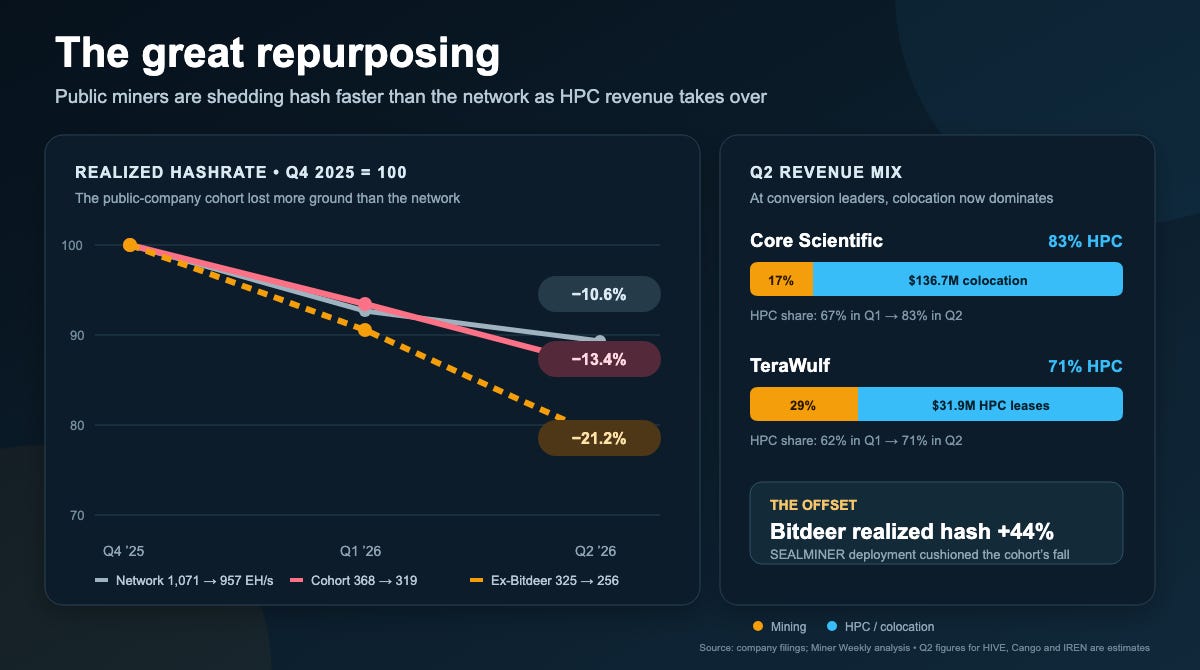
The miners reducing bitcoin exposure continued to unplug machines, but fewer operators expanded enough to compensate. At the same time, colocation revenue rose sharply among the companies furthest along in their conversions.
Core Scientific generated $136.7 million of colocation revenue in Q2, almost five times its $27.5 million of bitcoin mining revenue. Colocation supplied 83% of quarterly sales, up from 67% in Q1, according to the company’s second-quarter results.
TeraWulf followed the same trajectory. HPC lease revenue increased to $31.9 million, or 71% of total revenue, compared with $12.8 million from bitcoin mining. Its HPC share had already reached 62% in Q1 as contracted capacity at Lake Mariner began generating revenue.
For several miners, colocation is becoming a material contributor. At Core Scientific and TeraWulf, it has already overtaken mining.
The rest of the sector remains earlier in the conversion. Riot Platforms reported $23.2 million in data center revenue against $113.7 million from mining. Bitdeer generated $14 million from AI cloud services compared with $197.1 million from mining-related activities. Hut 8 and MARA reported smaller compute contributions, while Cipher and Keel Infrastructure had yet to recognize HPC revenue.
The offsets are no longer keeping up
Using an expanded cohort and updated network series, TheEnergyMag estimates that the public miners tracked for this analysis produced a combined realized hashrate of 368.3 EH/s in Q4 2025, 344.4 EH/s in Q1 2026 and 319.0 EH/s in Q2.
That represents a 13.4% decline in six months.
The Bitcoin network’s quarterly average fell from 1,071 EH/s to 993 EH/s and then to 957 EH/s over the same period, a 10.6% reduction. The public company cohort therefore contracted faster than the network.
In Q1, expansion by a handful of miners largely obscured the scale of the shutdowns elsewhere. By Q2, even those additions were no longer sufficient to keep the cohort stable.
Bitdeer remained the largest offset. Its realized hashrate increased 44% from Q4 to Q2, reaching 63.0 EH/s. Excluding Bitdeer, the rest of the cohort’s realized hashrate fell 21.2%, from 324.6 EH/s to 255.9 EH/s.
Bitdeer’s expansion comes from its own SEALMINER production pipeline. By June, the company reported 73 EH/s of self-mining capacity and 15.9 EH/s of co-mining capacity. It produced 990 bitcoin during the month, 388% more than a year earlier.
MARA and American Bitcoin also continued expanding, but their additions were not enough to counter reductions across Cango, Cipher, Keel, Core Scientific, TeraWulf and IREN.
Cango provides the sharpest example of how quickly mining economics have changed.
The company entered bitcoin mining in late 2024 and reached 50 EH/s of deployed capacity during 2025, only to begin decommissioning inefficient machines, leasing out hashrate and moving capacity toward lower-cost regions.
Its realized hashrate fell from 44.8 EH/s in Q4 2025 to 31.3 EH/s in Q1. TheEnergyMag estimates its Q2 capacity would decline to 16.5 EH/s—a 63% reduction in six months.
Keel Infrastructure has taken the transition further. During Q2, it completed the decommissioning of all U.S. bitcoin mining operations in preparation for data center construction. Mining continues in Canada during the phased transition. Meanwhile, the replacement revenue has not yet arrived.
The post-China arms race unwinds
The longer-term context also looks more striking after Q2.
China’s 2021 mining ban briefly removed roughly half the Bitcoin network’s computing power. Hashrate bottomed at 57.5 EH/s in June 2021, but miners relocated and the network had almost fully recovered by December. The United States emerged as the largest mining hub.
That recovery helped trigger the institutional expansion race TheEnergyMag has tracked over the ensuing years. Public miners raised capital, acquired power sites and ordered successive generations of ASICs, eventually pushing the network beyond one zettahash per second.
Only one halving has occurred since that expansion began.
Now, machines and electrical infrastructure accumulated during the post-China race are being idled, impaired or depreciated faster so their power can be reassigned to GPUs. The industry collectively expanded at enormous cost, only for some of its most visible operators to begin dismantling that capacity after one halving cycle.
Unlike the China ban, the current contraction has no single headline trigger. It is a combination of weak mining economics and a competing use for capital and electricity.
Hardware and Infrastructure News
Bitcoin ‘Anti-Spam’ Fork Sputters to a Halt After Mining Just Two Blocks
Nvidia, Wall Street Firms Target $500 Billion for AI Infrastructure
CenterPoint Ties $5B Savings Forecast to Texas Data Center Power Boom
Corporate News
MARA Pledges 18,750 BTC for $600 Million New Bitcoin-Backed Loans
Bitdeer Revenue Jumps 47% as Bitcoin Production Surges Nearly Fivefold
Keel Falls 10% as Revenue Halves, Shuts Bitcoin Mines for AI Data Centers
MARA Holdings Reports $611 Million Net Loss for Q2 2026
CleanSpark Secures $6.6 Billion Lease and Reports Third Quarter 2026 Financials
Bitdeer Slides 14% on $1B ATM Plan to Fund AI, HPC Expansion
Riot Jumps 20% on Anthropic AI Deal as Bitcoin Sales Surge 56%
CoreWeave Closes $2.6 Billion AI Loan at Wider Spread
CoreWeave Reports $2.58 Billion Q2 2026 Revenue Amid Infrastructure Expansion
HIVE Digital Delays Quarterly Report Over Swedish Tax Accrual
WhiteFiber Shares Jump as Contract Exit Payment Lifts Revenue
Nebius Revenue Jumps Fivefold as AI Cloud Deals Fuel Expansion
Cerebras Systems Details Q2 2026 Results, Reaching 600 MW of Contracted Data Center Capacity
This is the useful part of the miner/AI pivot story: hashrate is no longer the only asset being repriced. Sites, power access, cooling, uptime, and interconnects are the scarce inputs. For small miners, the scaled-down lesson is the same: measure the operating base before arguing from headline hashrate.
This is the same lesson at two scales. Public miners are being repriced around power, uptime, and higher-value compute. Home miners should shrink that discipline down to wall watts, stable hashrate, heat, rejects, and current difficulty before treating a desk miner like an income plan. Useful small-miner version: https://blockoddslabs.com/block-odds-calculator.html