


Today’s featured EIF speaker: Matt Prusak, President and Interim Chief Financial Officer of American Bitcoin (Nasdaq: ABTC), where he brings execution-focused leadership to the intersection of energy innovation and digital infrastructure. He previously led Ionic Digital’s bitcoin mining operations, helped build US Bitcoin Corp. into a North American market leader, scaled Curative’s nationwide COVID testing operations, and advised clients on capital markets, technology, and infrastructure at Bain & Company.
EIF Dallas (July 23-24) is a high-signal, curated conference convening leaders across energy, compute infrastructure, and capital to map the next decade of power and data center buildout.
Apply to speak or explore sponsorships for private meeting rooms, branding & more.
Situational Awareness LP has quickly become one of the more closely watched names in the AI investment world.
Founded by former OpenAI researcher Leopold Aschenbrenner, the Artificial General Intelligence (AGI)-focused investment firm has drawn attention for both its explosive growth and the controversy surrounding its founder’s dramatic firing from OpenAI and his subsequent polarizing manifesto about the future of AI.
Its latest SEC filing this week only adds to the intrigue.
The fund’s reported 13F portfolio more than doubled in the first quarter, rising to about $13.68 billion from about $5.52 billion at the end of 2025. Much of that increase came from a larger options book tied to semiconductors and AI infrastructure.
But buried inside the direct equity portfolio was another notable trend: Situational Awareness has been loading up on Bitcoin miners – and former miners. Not just any miners, either.
Across the past few quarters, the fund has built or expanded positions in companies that sit near the center of the Bitcoin-to-AI infrastructure trade: Applied Digital, Bitdeer, Keel (formerly Bitfarms), CleanSpark, Core Scientific, HIVE Digital, IREN, and Riot Platforms. Many of these companies are either actively expanding into AI and high-performance computing or are trying to reposition their power and data center footprints for that market.
At the same time, Situational Awareness has not treated the sector as a single basket. In Q1, it exited Cipher Digital and Hut 8 and trimmed Core Scientific. That makes the filing more interesting than a simple “AI fund buys miners” story.
It suggests the fund may be sorting the sector by a sharper question: which companies offer the most attractive exposure to monetized power infrastructure?
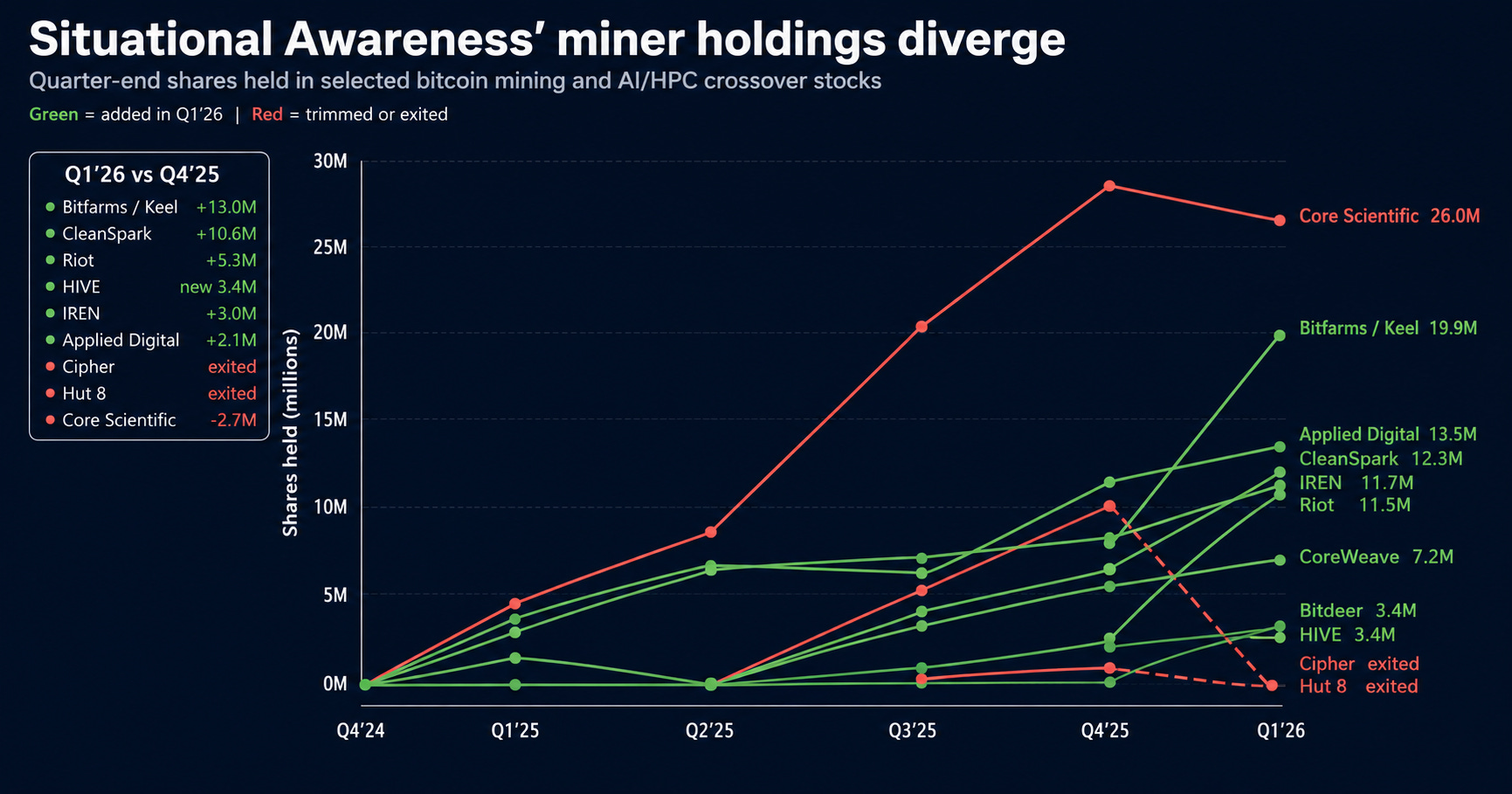
The Miners Situational Awareness Bought and Exited
The biggest increases in Q1 came from names that still have large Bitcoin mining footprints but also meaningful AI or HPC optionality.
Situational Awareness increased its Keel position to 19.88 million shares from 6.90 million at the end of 2025. It boosted CleanSpark to 12.28 million shares from 1.64 million, Riot to 11.50 million from 6.17 million, IREN to 11.70 million from 8.70 million and Bitdeer to 3.44 million from 1.79 million. It also opened a new 3.39 million-share position in HIVE Digital.
The fund also added to Applied Digital, raising its stake to 13.48 million shares from 11.34 million, and increased CoreWeave to 7.18 million shares from 6.10 million.
That group spans several versions of the same broader theme.
Applied Digital is increasingly an AI data center developer. IREN is moving deeper into AI neocloud and AI data centers while still operating a large Bitcoin mining base. Bitdeer combines self-mining, hosting, ASIC manufacturing and early AI cloud exposure. HIVE, while still mining-heavy, is also becoming more active on the HPC cloud front through BUZZ HPC, which has announced AI cloud contracts, a fiber upgrade, and a planned 320 MW sovereign AI infrastructure project in the Greater Toronto Area. Riot has moved beyond pure mining after signing AMD as its first hyperscale data center tenant at Rockdale. Keel has laid out plans to convert existing bitcoin mining facilities to HPC data centers and wind down mining operations altogether. CleanSpark remains more mining-heavy, but each controls energized infrastructure that could become more valuable if power remains the bottleneck for compute growth.
In other words, Situational Awareness appears to be buying across the power-to-compute stack, not merely the Bitcoin mining trade. But the fund’s exits and trims make the pattern more nuanced.
Situational Awareness fully exited Cipher Digital after holding 10.47 million shares at year-end. That is notable because Cipher has one of the sector’s most prominent AI/HPC pivot stories, including major contracted data center capacity.
It also exited Hut 8, another company that has attracted attention for its power-first AI data center strategy. Core Scientific, one of the highest-profile Bitcoin-to-AI colocation conversions, was trimmed slightly to 26.01 million shares from 28.76 million.
So the filing does not read like a blanket bet on every miner with an AI narrative. It looks more like a valuation-sensitive rotation within the group.
One Way to Read the Trade: Enterprise Value per Monetized MW
The market has increasingly valued miners based on power access. But “power access” is a loose term. Some megawatts are already energized and producing revenue. Some are contracted but still under construction. Some are tied to future AI leases. Others remain part of a development pipeline that may take years to monetize.
A stricter way to compare these companies is to look at enterprise value against revenue-generating megawatts: capacity that is already energized and producing revenue through Bitcoin mining, hosting, colocation, AI cloud or HPC services.
That lens helps explain why some of Situational Awareness’ largest additions were in names that look relatively cheaper on currently monetized power. The lower end of the table is where the fund did some of its most aggressive buying.
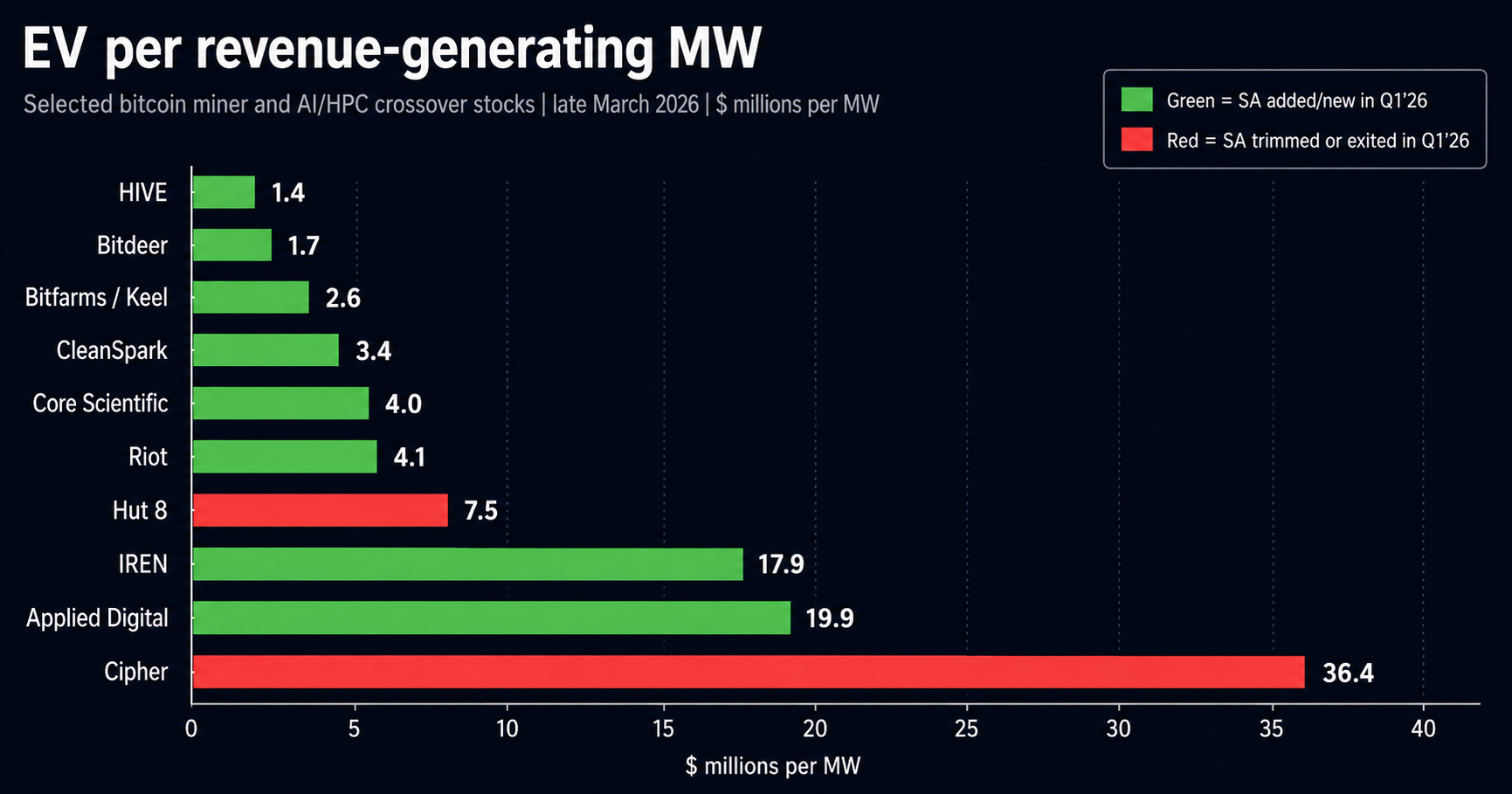
HIVE was a new position and screened as one of the cheapest names on this basis. Bitdeer, Keel, CleanSpark and Riot also had relatively low enterprise value per revenue-generating megawatt. Those are not all identical businesses, but they share one thing: the market was assigning less value to each currently monetized MW than it was for the more AI-branded infrastructure names.
That may be part of the appeal.
For an AI-focused fund, the bet does not have to be that every miner becomes the next CoreWeave. It may be enough that energized power, operating sites and data center know-how become more valuable as AI demand keeps colliding with grid constraints.
The other side: unpriced HPC optionality
There is another layer to the trade.
Situational Awareness may not simply be buying the cheapest revenue-generating megawatts. It may be buying the cheaper megawatts where future HPC conversion has not yet been fully priced in.
That distinction matters. A miner with a low EV per revenue-generating MW can be cheap for two very different reasons. It may be overlooked, or it may lack a credible path to higher-value AI/HPC monetization. The interesting names are the ones that still screen cheaply on current monetized capacity but also have enough power, sites, management credibility or customer pipeline to plausibly become HPC candidates.
Once a miner signs a major hyperscaler contract, the market quickly stops valuing it like a Bitcoin miner and starts valuing it like an AI infrastructure developer. Enterprise value rises, EV per current revenue-generating MW expands and the “cheap power” trade becomes less obvious.
Cipher may be the cleanest example. The company has one of the strongest AI/HPC pivot stories in the group, with hundreds of megawatts already contracted to hyperscale customers. Cipher disclosed a 907 MW current portfolio, including 700 MW of contracted gross HPC capacity and operating Bitcoin mining capacity. It also pointed to about 3.3 GW of grid pipeline capacity expected to be energized across 2027 to 2030 and beyond.
That success may also help explain why Situational Awareness exited the position. By the end of Q1, Cipher’s future HPC capacity was no longer just an idea. It was tied to announced customer agreements, and a large portion of that upside appeared to have been capitalized into the stock. On current revenue-generating MW, Cipher screened as one of the most expensive names in the group.
In other words, the exit may not have been a rejection of Cipher’s AI strategy. It may have been a valuation call after the market had already rewarded that strategy.
The same logic helps explain why lower EV/MW names such as Bitdeer, CleanSpark, Riot, HIVE and Keel may still be attractive to an AI-focused investor. They have large operating power footprints, but many have not yet announced the same scale of investment-grade hyperscaler contracts. If even a portion of those megawatts can be converted from Bitcoin mining to higher-value HPC or AI data center use, the rerating potential could be meaningful.
That may be the optionality Situational Awareness is buying: not just monetized power today, but monetized power that has not yet been fully repriced as AI infrastructure.
Hut 8 shows the risk of reading 13F filings too literally
Hut 8 is the counterexample.
Situational Awareness exited Hut 8 during Q1, before the company announced a major AI data center lease in May. That later announcement changed the way investors could value Hut 8’s power pipeline.
On May 6, Hut 8 said it had signed a 15-year, 352 MW AI data center lease at its Beacon Point campus in Texas with a confidential high-investment-grade tenant. The company said the base-term contract value was $9.8 billion, inclusive of a 3% annual base rent escalator. The market reaction was immediate with Hut 8 shares jumping nearly 30% to all-time highs over $100.
With the benefit of hindsight, Situational Awareness may have exited too early.
Before the Beacon Point contract, Hut 8 may have looked less compelling on currently monetized capacity compared with the lower EV/MW mining peers. After the announcement, the market had a clearer basis to value its development pipeline as contracted AI data center revenue.
That is exactly how the miner-to-AI trade can reprice.
First, companies get credit for energized power. Then they get credit for secured power. Then they get a much larger premium when that power becomes contracted to investment-grade AI/HPC customers.
Cipher appears to have already moved further into the third stage by the end of Q1. Hut 8 arguably moved there after the quarter ended. Some of the lower EV/MW miners remain earlier in that progression.
The bigger signal
The bigger story is that Situational Awareness’ miner exposure has become another sign of how deeply the AI trade has moved into energy infrastructure.
The fund is not just buying chip stocks. It is buying companies tied to the physical bottlenecks of AI growth: power, data centers, substations, energized land and operating compute sites.
Bitcoin miners happen to own a lot of that infrastructure. Some have cheap power. Some have large campuses. Some have interconnection rights. Some have teams that know how to operate high-density electrical load. That makes them relevant to an AI investor even when their core revenue is still Bitcoin mining.
But the Q1 filing also shows that the trade is becoming more selective.
The first phase of the miner AI pivot was about who had power. The next phase may be about whose power is already monetized, whose power can be upgraded for HPC, and whose future AI value has already been priced in.
The market may be buying the miners where the power is already working, the valuation is still reasonable and the AI optionality has not yet been fully priced in. At the same time, Cipher and Hut 8 show what can happen once that optionality becomes contracted AI data center revenue: the rerating can arrive fast, and sometimes after the 13F snapshot has already moved on.
Hardware and Infrastructure News
LU-VE Expands Texas Cooling Plant as AI Data Centers Drive Demand
Canaan to Heat 2,800 Nordic Homes With Bitcoin Miners
Hut 8 to fund $16 million water infrastructure project for Louisiana AI site
Soluna Buys Out Dorothy 1B as Bitcoin-to-AI Campus Conversion Advances
Applied Digital Inks $7.5B Lease for 300 MW at Polaris Forge 3, Expanding AI Factory Footprint
Corporate News
HIVE Plans CAD $3.5B Ontario AI Factory With 320 MW Power Allocation
NextEra Energy Confirms Deal to Acquire Dominion Energy in $400 Billion Utility Merger Fueled by AI Power Demand
Bitfury Entities Secure $81 Million Through Cipher Digital Forward Sale Agreements
Situational Awareness Deepens AI Power Bets, Adds Bitcoin Miners in Q1 Portfolio Shift
NextEra Energy and Dominion Energy Outline Post-Merger Leadership and Structure
Financial News
Bitdeer Reports Q1 2026 Revenue of $188.9 Million and Positive Adjusted EBITDA
IREN Closes $3 Billion Convertible Deal after AI Push Draws Bigger Backing
Fluence Energy Announces $420 Million Secondary Offering by Selling Securityholders
CoreWeave’s New $3.1B Loan Tests Wider Market for AI Infrastructure Debt
Canaan Posts $62.7M in Q1 Revenue as Mining Footprint Expands to 11 EH/s