



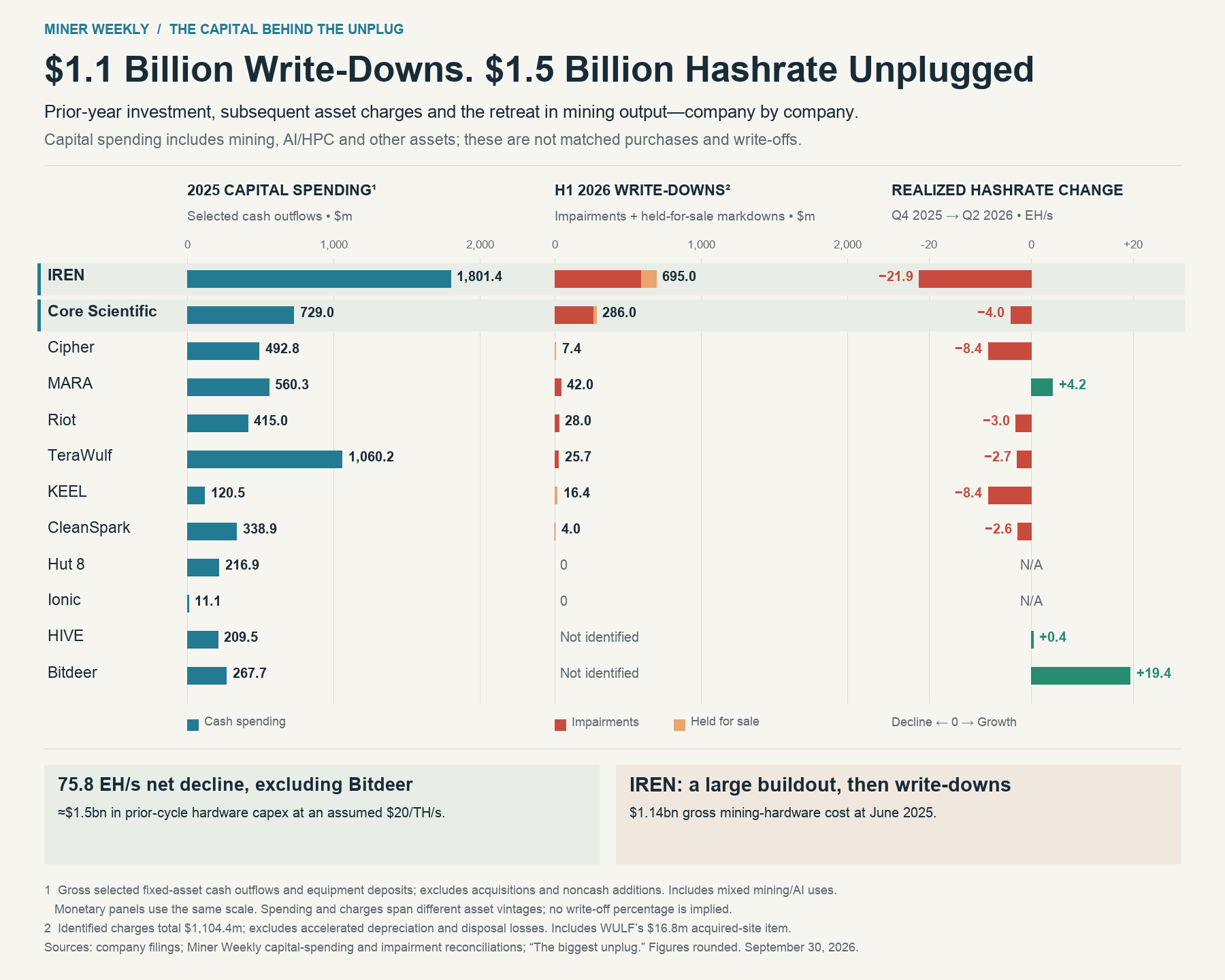
The hashrate public bitcoin miners shed in the first half of 2026 carries an uncomfortable price tag: roughly $1.5 billion in equivalent hardware investment, even at an assumed acquisition price of just $20 per terahash (TH/s).
A previous Miner Weekly issue estimated that public miners lost 75 EH/s of realized hashrate while their directly reported HPC and AI revenue rose 52% quarter over quarter. Much of that retreat reflected a redirection of power toward AI infrastructure.
The revenue growth showed what operators were gaining. But putting a purchase price on the disappearing hashrate helps illuminate what they had already paid for.
At $20 per TH/s, 75 EH/s corresponds to $1.5 billion of mining machines. That excludes the buildings, electrical equipment, cooling and installation needed to operate them.
That is an often-overlooked cost of the AI transition: investors had already financed the mining capacity being displaced. At some sites, equipment was marked down within months of starting production, raising questions about how much of that investment mining could recover before AI took over.
And the accounting consequences are becoming visible.

A separate review by TheEnergyMag of 12 tracked companies identified approximately $1.1 billion in asset impairments and held-for-sale markdowns during the first half of 2026. IREN and Core Scientific accounted for almost 89% of the total.
The similarity between the two billion-dollar figures may seem coincidental. One estimates hardware investment equivalent to a reduction in mining output; the other measures disclosed accounting charges across different assets and companies.
But both point toward the same investment question: how much value remains in the mining buildout as operators redirect their sites toward another business?
The spending surge was recent. A March 2025 Miner Weekly issue reported nearly $5 billion in equipment and infrastructure spending across the preceding reporting cycle. Companies that separately disclosed mining-hardware purchases accounted for more than $3 billion in 2024 alone.

That expansion helped push Bitcoin’s network into zetahash territory in 2025. Operators bought more efficient machines and added capacity to defend their share of production, while their competitors did the same.
Now, some of those investments are being displaced much sooner than the scale of the spending might suggest.
Cipher’s Black Pearl facility began mining in mid-2025. By year-end, following an agreement to convert the site to high-performance computing, Cipher had recorded a $96.1 million markdown specifically on Black Pearl’s mining machines. Those same machines generated $57.9 million in revenue during 2025—meaning the markdown exceeded the site’s revenue from its first several months of operation.
That comparison does not establish the project’s lifetime return, but it captures the compressed timetable. A newly operating mine was already preparing for a different purpose. Cipher’s charge also occurred before the first-half 2026 write-down total.
IREN illustrates the scale. It reached 50 EH/s in June 2025, then recorded roughly $695 million in impairments and held-for-sale markdowns during January–June 2026, with substantial charges associated with mining assets displaced by AI conversions.
Not every charge is an AI conversion cost. Core Scientific attributed its major mining impairment to deteriorating mining economics. The broader total includes other asset categories as well. The evidence supports a costly reassessment of mining investment, rather than a claim that every dollar was sacrificed for AI.
Interest arrives before the revenue ramp
While write-downs are noncash when recognized, construction and interest payments continue to consume cash when replacement facilities are being completed.
TeraWulf generated approximately $53 million in HPC leasing revenue during the first half while paying $131 million in cash interest across the company. Cash reserves and other income also support those obligations, so the comparison is not a standalone measure of financial distress. It shows the gap between the revenue ramp and the cost of financing it.
Access to the next round of funding may also become harder. According to an excerpt from The Information’s reporting on Thursday, Société Générale and SMBC have become more selective about data center financing, while MUFG is also stepping back.
That would add another constraint for miners midway through conversions: retiring mining capacity reduces the old revenue stream, while completing its replacement still requires capital. More selective lenders could mean tougher terms, additional equity funding or a slower buildout.
At the same time, delays can extend that period after mining revenue has already been reduced. Oracle is not a miner, but the recent news on Project Jupiter offers a concrete example of how power constraints can reach the financial arrangements behind an AI campus.
The underlying setback is documented: New Mexico’s land commissioner again rejected a request in July to route part of the project’s natural-gas pipeline through state trust lands. Jupiter’s planned fuel-cell power system depends on natural gas.
A delayed campus opening is not established. What is clear is that energy delivery risk has become a question of contractual obligations and who pays while a project waits.
Communities are demanding more control
That uncertainty sits within a widening political debate over data centers’ electricity demand, water use and effects on household bills. New York announced a pause on state environmental permits for new hyperscale projects. Massachusetts introduced additional approval requirements, while Chicago’s mayor proposed a year-long moratorium.
Existing mining sites may become more valuable where they offer usable power access. But conversions still need to satisfy technical requirements and obtain applicable approvals.
The cost of waiting is also facing renewed interest-rate pressure with the Federal Reserve raising its benchmark range by a quarter point to 3.75%–4%. Existing fixed-rate debt retains its terms, but new financing, floating-rate borrowing and refinancing face a less forgiving backdrop.
AI may ultimately prove the better use of these sites, but the return on the AI transition will depend on more than the revenue produced by each converted megawatt. It will also depend on the value recovered from the mining equipment, the cost of rebuilding the site, and how long lenders must be paid before the new capacity begins earning.
Hardware and Infrastructure News
Oracle Shares Fall 4% on Reported Bid to Defer Payments on AI Project
Applied Digital Confirms Brookwood, Alabama, as Site of Delta Forge 2 AI Factory
Cipher Secures 20-Year Barber Lake Commitment Worth Over $9 Billion
Lambda Plans Oklahoma Data Center, Projects $500 Million in Taxes
Crusoe Details Google’s Texas AI Campus, With Links to 531 MW of Wind
Bitdeer AI Secures $1.7 Billion in Off-Take Agreements for Malaysia Data Center
Corporate News
MARA Posts $100M Deposit, Reworks Texas Deal Amid Data Center Audit
Hut 8 Secures $1B Revolving Credit Facility to Support AI Infrastructure Growth
NVIDIA Boosts Share Buyback $150 Billion Through 2028
Soluna and Bitdeer increase capacity at Project Kati 1 to 35 MW
Financial News
Nscale Secures $3.36 Billion in Pre-IPO Financing Led by Third Point
Riot Repays Coinbase Loan, Ends $200 Million Bitcoin-Backed Facility
Anthropic Eyes $2 Trillion IPO Valuation After $7.3 Billion Compute Spend
OpenAI Seeks at Least $30 Billion at $1.4 Trillion Valuation
Feature
The AI Build-Out Is Becoming the Biggest Economic Bet in U.S. History -WSJ
Cracks Emerge in AI’s Debt-Fueled Data Center Boom - The Information