


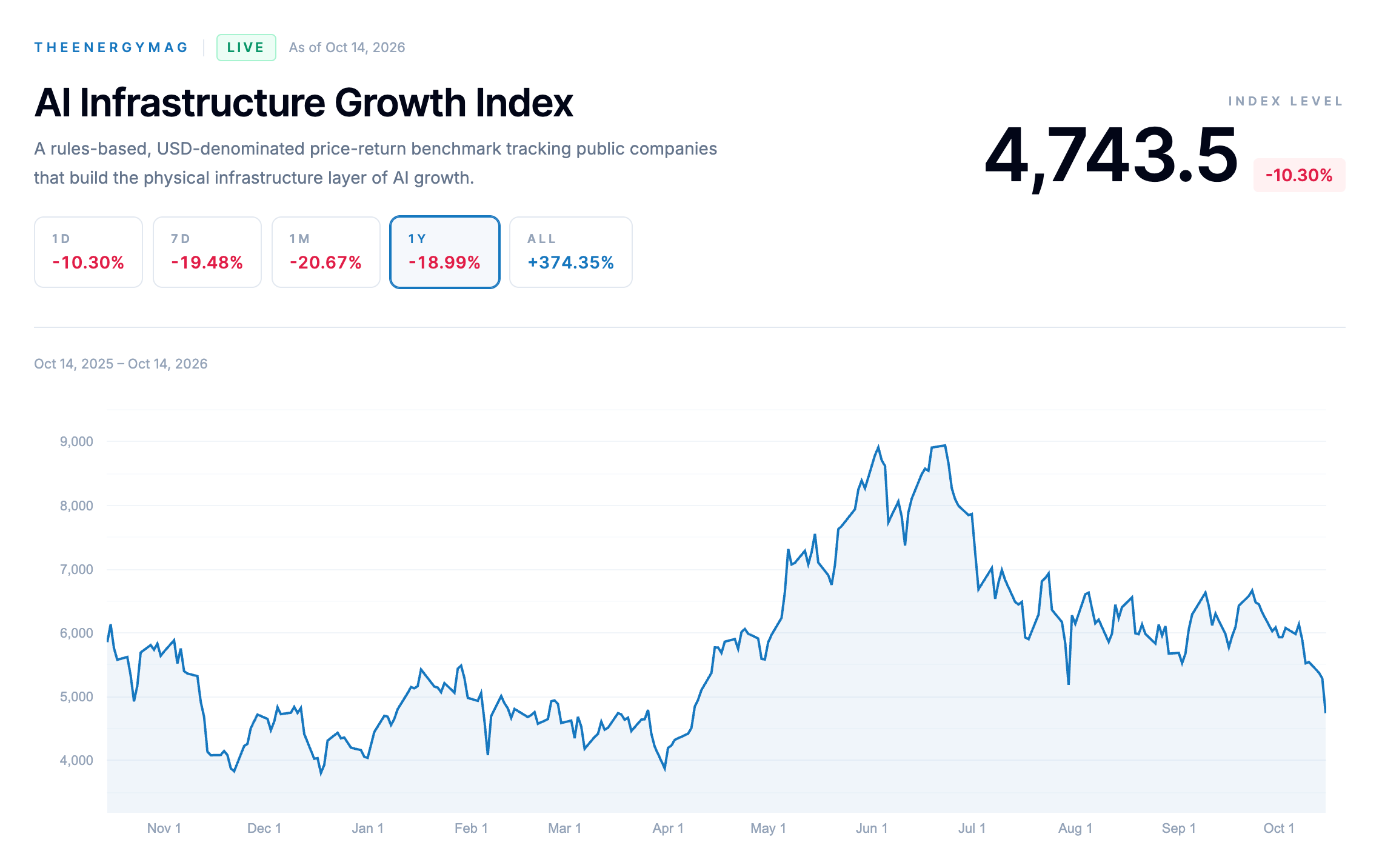
About $74 billion in equity market value disappeared from the 20 companies tracked by TheEnergyMag over the past week, reflecting mounting concern about the debt financing the AI buildout. The question is whether investors are recognizing credit risks they previously overlooked—or whether online alarm is pushing the selloff beyond what the underlying finances justify.
TheEnergyMag’s AI Infrastructure Growth Index was down nearly 20% over the past 7 days and recorded a 10% decline on Wednesday alone.
It unfolded in a sequence familiar to anyone who has followed crypto markets: a worrying chart, a prominent investor’s warning and a short reply that travels further than the financial details. It’s easy to label the resulting anxiety FUD—fear, uncertainty and doubt. But the underlying credit concerns are harder to dismiss.
The Neocloud selloff gets a megaphone
At the center of the recent selloff, Neoclouds like Nebius and CoreWeave accounted for about $26.4 billion of the weekly loss—more than a third of the total from just two companies. CoreWeave had fallen approximately 25.4% from its October 7 close. Nebius was down about 21.6%.
Both businesses depend on getting an expensive sequence right: secure equipment and data center capacity, bring it online, then collect enough revenue to justify the investment. Financing has to remain available while that happens.
In his October 13 post on AI and private credit, VC investor Chamath Palihapitiya questioned whether lenders were adequately pricing the risks. His follow-up highlighted CoreWeave’s 2032 bond yield touching 15% before closing around a record 14.5%. Elon Musk’s reply helped carry the concern beyond the usual credit-market audience.


Crypto investors know how quickly these conversations can compress. Questions about one company’s financing become questions about everyone’s balance sheet. Falling prices then appear to validate the concern, drawing more attention to the original warning.
That is a useful lens here, although it cannot tell us how much selling the posts caused. Chamath’s chart documented a bond move already underway, but sentiment and financing can reinforce each other. Falling bond prices can signal tougher terms for future borrowing. Falling shares make equity fundraising more dilutive.
Dismissing the concern as online noise would miss that connection. Treating every falling stock as confirmation of the worst-case scenario would miss the differences between companies.
We have been watching this bill come due
A previous Miner Weekly issue looked at the pressure already building.

Fourteen companies tracked by TheEnergyMag brought in $48.24 billion of net financing across their latest six-month reporting periods. Net debt supplied $35.09 billion, nearly 73%. CoreWeave, Nebius, Hut 8 and IREN accounted for roughly 76% of the financing inflow – and three of them are neoclouds.
CoreWeave shows how strong growth and financial pressure can coexist. Its second-quarter revenue more than doubled to $2.575 billion. Net interest expense reached $640 million—roughly a quarter of revenue. It also reported approximately $104 billion of backlog, with revenue recognition dependent on delivery and service availability. The challenge is turning them into cash on a schedule that works for the balance sheet.
And that 15% bond yield needs some context. It does not suddenly reset the rate on all of CoreWeave’s debt. It tells us what return investors demand to buy that particular bond at its market price—a warning worth watching when more financing may be needed.
The next dollar is getting more expensive
Wednesday’s inflation report gave investors another reason to worry. September CPI rose 3.7% from a year earlier, up from 3.4% in August and above economists’ 3.6% forecast. Traders increased their bets on another Fed rate hike as Treasury yields rose and stocks came under broader pressure.
That adds a second layer to the AI financing concerns. Investors are questioning individual borrowers’ creditworthiness while also reassessing how expensive money could become across the economy. For companies still funding large construction and equipment commitments, higher benchmark rates and a bigger premium for credit risk can compound the pressure.
The CPI release cannot explain the entire week’s losses, but it helps explain why Wednesday’s selling reached beyond the companies drawing attention on X.
Investors are also looking harder at the revenue assumptions behind AI spending. October 8 reporting put OpenAI’s September annualized revenue near $50 billion, below the roughly $70 billion previously circulated. The difference involved gross-versus-net accounting for partner sales; it does not mean $20 billion of demand vanished.
Anthropic offered a more encouraging picture at its October 14 investor meeting in San Francisco. Attendees told Reuters that third-quarter revenue reached $16.8 billion, up 45% from the previous quarter, and that the company reported an adjusted profit. Analysts who met executives estimated its annual revenue run rate could reach $110 billion by year-end. That is a projection of its revenue pace, rather than $110 billion of sales expected across 2026.
Those figures complicate the idea that AI demand is running out of steam. But strong growth at a model developer does not guarantee attractive returns for every infrastructure supplier. The credit question remains whether cash reaches each borrower fast enough to cover its obligations. Competition, equipment spending and interest costs can absorb much of the upside even as usage keeps climbing.
There is another bill to watch
Political uncertainty may also be adding to the unease. With the midterms approaching and forecasts pointing toward Democratic gains in the House, investors have another question to weigh: how might the rules around the AI buildout change? That is a plausible source of concern, even if its contribution to the selloff is difficult to isolate.
The political pressure is already visible—and crosses party lines. As explored in a previous issue, concerns about household electricity bills, water use and local control are dividing even the Republican coalition behind Trump’s AI ambitions.

Those arguments have financial consequences. Longer approvals can delay revenue, while stricter requirements to fund grid upgrades or pay for reserved capacity can add obligations before a facility starts earning.
At the center of the debate is a deceptively simple question: will a new data center raise the neighbors’ electricity bills—and who should pay if it does?
That is the starting point for a new four-part Explainer series by TheEnergyMag. The first installment, “Your Electricity Bill Is More Than the Electricity You Use,” breaks down what households actually pay for and how data-center demand can change the equation. Understanding those costs helps make sense of both the political backlash and the financial risks investors are trying to price.
Regulation News
KEEL-Linked 75 MW Data Center Wins Conditional Approval in Allentown
Hardware and Infrastructure News
Bitdeer Secures 67MW AI Data Center Campus in Malaysia, Bringing Total to 273.5MW
Bitdeer AI Secures 60MW Data Center Agreement in Malaysia to Reach 95% of Global Capacity Target
Binance to Shut Mining Pool After Years of Market Share Losses
Core Scientific’s Billing AI Data Center Capacity Rises to 485 MW
Corporate News
Duke Energy Reaches Data Center Cost Deal With Tech Giants
CleanSpark to End Monthly Mining Updates as Data Center Business Expands
Financial News
Nvidia-Backed Firmus Scraps $5B Australian IPO, Seeks Private Funding
IREN Rises Overnight After Report of Anthropic AI Cloud Deal
SWI Raises €800M to Fund AI Push After Genesis Digital Takeover
Cipher Digital Plans $850 Million Convertible Sale to Fund Data Centers
CoreWeave Falls 7% Premarket as Bond-Yield Surge Fuels Debt Concerns
Feature
TEM Explainer Series: Your Electricity Bill is More Than the Electricity You Use